History, what do you mean that Folkways Records was founded by the son of Sholem Asch who, as one last trick after the scandals of Jewish lesbians and Christian novels, wrote a version of the Nativity recorded for his son's record label by Pete Seeger? What kind of concatenation is that to drop on an unsuspecting person? And is there a reason no artist is credited with the pen-and-ink illustrations depicting the story in 1963 even as the prose sticks to its historical setting, which are maddening me with their sketch-expressive familiarity, although perhaps only because my grandmother had that kind of loose, scribbly, ink-washed line? Ben Shahn at least had the decency to sign his album art. The Claibornes' "Listen, Mr. Bilbo" could have had the luck to lose its relevance since 1946. History, the other kind of convergence was more fun. Listen while I tell you that the foreigners you hate are the very same people made America great.


In the midst of this week, we are in a block of doctor's appointments, but following this afternoon's I climbed up to the railings behind the Salem Street Burying Ground and hung over them with my camera, an operation which still put me in snow to mid-calf. Its winter-drifted gravestones date from the late seventeenth through the late nineteenth centuries, with one modern interpolation for the unmarked, enslaved dead. I should go back for their slate-carved winged skulls in spring.

The current sunset is one of those violet riots, but at the time of this photo, the clouds above the fan of trees were just starting to flush gilt-grey. That attenuated stretch of the Mystic that always looks more like an industrial canal than a river was a glaucous freeze at its margins and flat-skimmed snow down its center. I cannot believe I never encountered Socalled's Ghettoblaster (2006) until its twentieth anniversary. Then again, only forty years after the fact did it occur to me that I would have accepted The Last Battle (1956) much more readily if Lewis had made it Ragnarök instead of Revelations.

The current sunset is one of those violet riots, but at the time of this photo, the clouds above the fan of trees were just starting to flush gilt-grey. That attenuated stretch of the Mystic that always looks more like an industrial canal than a river was a glaucous freeze at its margins and flat-skimmed snow down its center. I cannot believe I never encountered Socalled's Ghettoblaster (2006) until its twentieth anniversary. Then again, only forty years after the fact did it occur to me that I would have accepted The Last Battle (1956) much more readily if Lewis had made it Ragnarök instead of Revelations.
Mailing our census form back to the city turned out to be slightly more of a Shackletonian trek than I had prepared for, not because I had failed to notice the maze of sidewalks and driveways tunneled out of the snow-walls on our street or the thick-flocked snowfall that had restarted around sunset, but because I had expected some neighbor to have snowblown or at least shoveled the block with the post box on it. It stood amid magnificent, inviolate drifts. I waded. At 18 °F and wind chill, my hands effectively quit on me within five minutes, but even between their numbness and my camera's increasing preference not to, I did manage to take a couple of pictures I liked.
( Laughter doesn't always mean. )
JSTOR showcased Laura Secord with the result that I had to listen, thanks these aeons ago to![[personal profile]](https://www.dreamwidth.org/img/silk/identity/user.png) ladymondegreen, to Tanglefoot.
ladymondegreen, to Tanglefoot.
It is a sign of how badly the last three years in particular have accordioned into one another that my reaction to discovering last year's new album from Brivele was the pleased surprise that it followed so soon on their latest EP. I am intrigued that they cover the Young'uns' "Cable Street" (2017), which has for obvious reasons been on my mind.
I can find no further details on the secretary from the North Midlands who appears in the second half of this clip from This Week: Lesbians (1965), but if there was any justice in the universe the studio should have been besieged with letters from interested women, because in explaining the problems of dating, she's a complete delight. "Well, that's the difficulty. In a way, it means that I have to keep making friends with people because I can't find out unless I make friends with them and then if they are lesbian, there's hope for me, but even then there isn't hope unless they happen to take to me!"
( Laughter doesn't always mean. )
JSTOR showcased Laura Secord with the result that I had to listen, thanks these aeons ago to
ladymondegreen, to Tanglefoot.It is a sign of how badly the last three years in particular have accordioned into one another that my reaction to discovering last year's new album from Brivele was the pleased surprise that it followed so soon on their latest EP. I am intrigued that they cover the Young'uns' "Cable Street" (2017), which has for obvious reasons been on my mind.
I can find no further details on the secretary from the North Midlands who appears in the second half of this clip from This Week: Lesbians (1965), but if there was any justice in the universe the studio should have been besieged with letters from interested women, because in explaining the problems of dating, she's a complete delight. "Well, that's the difficulty. In a way, it means that I have to keep making friends with people because I can't find out unless I make friends with them and then if they are lesbian, there's hope for me, but even then there isn't hope unless they happen to take to me!"
The snow has built a slice of six or eight inches against the glass of my office window, like the honeycomb of an observation hive. Out in the street it looks twice that height not counting the drifts which have crusted where the sidewalks used to be and swamped at least one car and its forlorn antennae of windshield wipers. I would have enjoyed more of the snowglobe of the day without the return of the phantom detergent which spatch could smell even through the storm as soon as he turned up North Street, but I took a picture early on in the snowfall. None of the needles are visible any more.

I can't believe no one has ever written a crossover between Mavis Doriel Hay's Death on the Cherwell (1935) and Dorothy L. Sayers' Gaudy Night (1935). It must have been unspeakably awkward for Oxford to suffer two unrelated criminal investigations in separate women's colleges in the same year. Just as Sayers modeled her Shrewsbury College on Somerville, Hay fashioned her Persephone College after her own alma mater of St Hilda's and then inflicts on it the discovery of the body of the college bursar by the same quartet of students who were meeting that afternoon to hex the victim with no expectation of such immediate or spectacular results. They plunge into the business of detecting with the same gestalt enthusiasm, a fast-paced, fair-play, often very funny blend of detective and campus novel as their amateur sleuthing attracts the competitive interest of an equivalent circle of male students as well as the police and the resigned relatives who starred in the author's previous Murder Underground (1934). Every now and then an appropriately chthonic allusion surfaces from the winter damp hanging over the river which loops around Perse Island and its contested territory to which an Elizabethan curse may be attached, but it's not, thank God, dark academia; the ordinary kind can be lethal enough. With its female-forward cast and its touches of social issues in the humor, it would have made a terrific quota quickie. "Undergraduates, especially those in their first year, are not, of course, quite sane or quite adult. It is sometimes considered that they are not quite human."
It delights me deeply that my mother regards the young Mel Brooks, as pictured c. 1949 in a recent edition of the Globe, as a snack.
spatch could smell even through the storm as soon as he turned up North Street, but I took a picture early on in the snowfall. None of the needles are visible any more.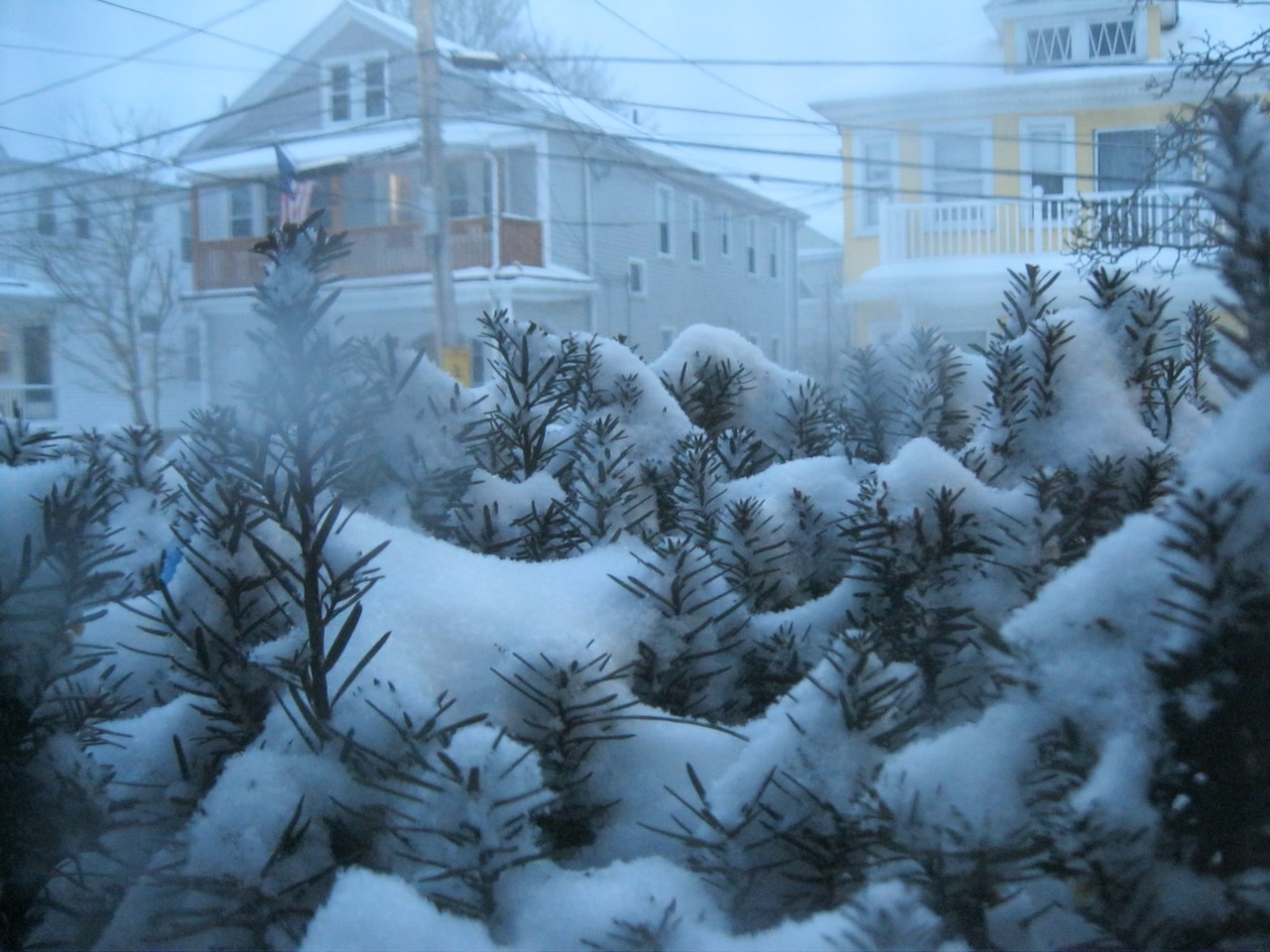
I can't believe no one has ever written a crossover between Mavis Doriel Hay's Death on the Cherwell (1935) and Dorothy L. Sayers' Gaudy Night (1935). It must have been unspeakably awkward for Oxford to suffer two unrelated criminal investigations in separate women's colleges in the same year. Just as Sayers modeled her Shrewsbury College on Somerville, Hay fashioned her Persephone College after her own alma mater of St Hilda's and then inflicts on it the discovery of the body of the college bursar by the same quartet of students who were meeting that afternoon to hex the victim with no expectation of such immediate or spectacular results. They plunge into the business of detecting with the same gestalt enthusiasm, a fast-paced, fair-play, often very funny blend of detective and campus novel as their amateur sleuthing attracts the competitive interest of an equivalent circle of male students as well as the police and the resigned relatives who starred in the author's previous Murder Underground (1934). Every now and then an appropriately chthonic allusion surfaces from the winter damp hanging over the river which loops around Perse Island and its contested territory to which an Elizabethan curse may be attached, but it's not, thank God, dark academia; the ordinary kind can be lethal enough. With its female-forward cast and its touches of social issues in the humor, it would have made a terrific quota quickie. "Undergraduates, especially those in their first year, are not, of course, quite sane or quite adult. It is sometimes considered that they are not quite human."
It delights me deeply that my mother regards the young Mel Brooks, as pictured c. 1949 in a recent edition of the Globe, as a snack.
It is always a beautiful day to yell at God, but while you are waiting to take a number for that extremely lengthy line, you might as well stand with Minnesota. Maine, too. I had thoughts about Stolpersteine and Fugitive Slave Acts, but in terms of coherent expression I spent most of my day reacting to the wave of something like scented detergent or dryer sheets that rolled out of the heating system around nine in the morning and stopped me sleeping or particularly breathing well.
I have been re-reading my second edition of Estel Eforgan's Leslie Howard: The Lost Actor (2010/13) which remains a wealth of otherwise inaccessible information with a close eye to the complex interplay of his biography and screen persona. I still disagree frequently with her criticism, but the detail of her research does things like offer a potential reconciliation between the family stories that Leslie was shell-shocked out of the First World War and the absence of his name from any records of active service in France: toward the end of his short stint as a second lieutenant with the Northamptonshire Yeomanry in the spring of 1916, his regiment was billeted with various divisions at Harponville, Ypres, and Arras, where it would have been possible to be officially non-combatant and still, in the immortal words of Frederic Manning, shelled to shit. Leslie himself never claimed to have seen combat, confiding in one of his broadcasts in 1940, "I am willing to let you figure out the degree of my senility by telling you that during most of the last war I was a very junior officer in a cavalry regiment. However, long before I got anywhere near the battlefront, everybody had settled down into trenches, and as horses are practically useless in trenches I found myself near Divisional Headquarters, pretty bored but pretty safe." His daughter records in her memoir A Quite Remarkable Father (1959) that his violent nightmares which could wake anyone within earshot were understood by his family to be connected to his war. She does not seem to have wondered the same about his self-admitted knack for dissociation or his rare but explosive losses of temper. Eforgan follows her in attributing his conviction of heart trouble to hypochondria; it occurred to me that pre-DSM, a person who regularly woke himself shouting and dreaded traveling alone, especially by train in case he shouted his fellow passengers awake with him, could be forgiven the common confusion of a panic for a heart attack. I found Leslie Ruth Dale-Harris née Howard through some cross-checks on Eforgan and the interstitial material contributed by Ronald Howard to Trivial Fond Records (1982) and her portrait of her father is fascinatingly the most fragile of the three, especially since much of what she regards affectionately as his eccentricities and his foibles looks very little out of the ordinary to me, e.g. a capacity for effortless, spellbinding charm right up until his social meter ran out and he had to leave his own party to fall asleep. A droll sense of humor on his own time, a steel-trap comfort with last-minute rewrites and improvisations, and he couldn't tell a formal joke to save his life without cracking himself up over it or lie without self-conscious same. Fifteen years after his death, his daughter still seems amazed that her famously disorganized father, the same nervous mess who had forgotten the ring at his own wedding and needed reminding of everything from call times to the necessity of food, a regular Menakhem-Mendl of the British film industry if she had just acknowledged his Jewishness—like his non-monogamy, it is elided with mid-century tact—threw himself so obstinately and intently into the war effort even when it ran him directly against the prejudices and proscriptions of the Ministry of Information and the BBC. He doesn't just start to look his age in the last years of his life, he looks recklessly burning himself to make his films and his broadcasts and his tours and his connections that Eforgan documents with the Free French and SOE. About a month into the Blitz, he noted with characteristic self-deprecation that after his London flat took a direct hit, "I decided to heed the exhortation of the popular song and 'get out of town'. In fact, I got out of town with a quite undignified haste, arguing to myself that one can prepare a film for production just as well in the country." He continued to travel weekly into London for work until his final tour for the British Council in 1943 and I don't know what he dreamed for any of it. R.I.P. ADH2*2, three cocktails put him literally on the floor.
I seem unable to think about movies except in this secondhand fashion, but I wrote another fill (AO3) for![[community profile]](https://www.dreamwidth.org/img/silk/identity/community.png) threesentenceficathon. This year it's a lot of noir.
threesentenceficathon. This year it's a lot of noir.
I have been re-reading my second edition of Estel Eforgan's Leslie Howard: The Lost Actor (2010/13) which remains a wealth of otherwise inaccessible information with a close eye to the complex interplay of his biography and screen persona. I still disagree frequently with her criticism, but the detail of her research does things like offer a potential reconciliation between the family stories that Leslie was shell-shocked out of the First World War and the absence of his name from any records of active service in France: toward the end of his short stint as a second lieutenant with the Northamptonshire Yeomanry in the spring of 1916, his regiment was billeted with various divisions at Harponville, Ypres, and Arras, where it would have been possible to be officially non-combatant and still, in the immortal words of Frederic Manning, shelled to shit. Leslie himself never claimed to have seen combat, confiding in one of his broadcasts in 1940, "I am willing to let you figure out the degree of my senility by telling you that during most of the last war I was a very junior officer in a cavalry regiment. However, long before I got anywhere near the battlefront, everybody had settled down into trenches, and as horses are practically useless in trenches I found myself near Divisional Headquarters, pretty bored but pretty safe." His daughter records in her memoir A Quite Remarkable Father (1959) that his violent nightmares which could wake anyone within earshot were understood by his family to be connected to his war. She does not seem to have wondered the same about his self-admitted knack for dissociation or his rare but explosive losses of temper. Eforgan follows her in attributing his conviction of heart trouble to hypochondria; it occurred to me that pre-DSM, a person who regularly woke himself shouting and dreaded traveling alone, especially by train in case he shouted his fellow passengers awake with him, could be forgiven the common confusion of a panic for a heart attack. I found Leslie Ruth Dale-Harris née Howard through some cross-checks on Eforgan and the interstitial material contributed by Ronald Howard to Trivial Fond Records (1982) and her portrait of her father is fascinatingly the most fragile of the three, especially since much of what she regards affectionately as his eccentricities and his foibles looks very little out of the ordinary to me, e.g. a capacity for effortless, spellbinding charm right up until his social meter ran out and he had to leave his own party to fall asleep. A droll sense of humor on his own time, a steel-trap comfort with last-minute rewrites and improvisations, and he couldn't tell a formal joke to save his life without cracking himself up over it or lie without self-conscious same. Fifteen years after his death, his daughter still seems amazed that her famously disorganized father, the same nervous mess who had forgotten the ring at his own wedding and needed reminding of everything from call times to the necessity of food, a regular Menakhem-Mendl of the British film industry if she had just acknowledged his Jewishness—like his non-monogamy, it is elided with mid-century tact—threw himself so obstinately and intently into the war effort even when it ran him directly against the prejudices and proscriptions of the Ministry of Information and the BBC. He doesn't just start to look his age in the last years of his life, he looks recklessly burning himself to make his films and his broadcasts and his tours and his connections that Eforgan documents with the Free French and SOE. About a month into the Blitz, he noted with characteristic self-deprecation that after his London flat took a direct hit, "I decided to heed the exhortation of the popular song and 'get out of town'. In fact, I got out of town with a quite undignified haste, arguing to myself that one can prepare a film for production just as well in the country." He continued to travel weekly into London for work until his final tour for the British Council in 1943 and I don't know what he dreamed for any of it. R.I.P. ADH2*2, three cocktails put him literally on the floor.
I seem unable to think about movies except in this secondhand fashion, but I wrote another fill (AO3) for
threesentenceficathon. This year it's a lot of noir.On a theory, I believe, of sustaining me on literature, my parents very unexpectedly presented me with my own copy of Leslie Howard's Trivial Fond Records (ed. Ronald Howard, 1982), which seems to have shipped from the UK as if the international post just worked.
Well, here we are, the 29th of July, 1940. What have we done with all the years since 1918? Armistice night in Piccadilly Circus is so vivid in the memory, it seems like last Wednesday week. What did happen to all those years – and what have we done with them? It seems we are back where we began. Anyway, there it is on the calendar, July 1940, and this war has been on for eleven months. And I am in London speaking these words, and when I am finished talking to you I shall go out of this building, past sandbags and bayonets, into streets of medieval blackness. As I hunt for the two pin-points of light that represent a taxi it will be about two a.m. here, which is nine in the evening your time, and I shan't be able to resist a thought of the dazzling glare which at that moment is lighting the sky above New York's Great White Way. I daresay there isn't an Englishman alive who is more familiar than I with Broadway at nine o'clock on a summer's evening.

Well, here we are, the 29th of July, 1940. What have we done with all the years since 1918? Armistice night in Piccadilly Circus is so vivid in the memory, it seems like last Wednesday week. What did happen to all those years – and what have we done with them? It seems we are back where we began. Anyway, there it is on the calendar, July 1940, and this war has been on for eleven months. And I am in London speaking these words, and when I am finished talking to you I shall go out of this building, past sandbags and bayonets, into streets of medieval blackness. As I hunt for the two pin-points of light that represent a taxi it will be about two a.m. here, which is nine in the evening your time, and I shan't be able to resist a thought of the dazzling glare which at that moment is lighting the sky above New York's Great White Way. I daresay there isn't an Englishman alive who is more familiar than I with Broadway at nine o'clock on a summer's evening.

My poem "Northern Comfort" has been accepted by Not One of Us. It was written out of my discovery over the last few years of the slaveholding history of Massachusetts literally under my feet and my more recent anger at the murderously terrified fragility of the current administration. Half my family turns out to be wound into these vanguards of American colonialism and I don't waste my time pretending that the other immigrant half bullied me into demonizing them to death. At this point I am moving past hundred-year tides and into glaciers.
I cannot promise at this stage to do anything more than admire them, butthisbluespirit made me a pair of personalized bingo cards.
( These sisters waiting to wear their own clothes. )
Having entirely missed the existence of Winteractive these past three years, I can see that I will have to visit the Kraken Crossing before the end of March. In even more belated fashion, I have managed to go more than thirty years without seeing the 1995 BBC Pride and Prejudice partly because nearly everyone I knew in high school was fainting over it and my reactions to most expressions of romance at that time could be described as allergic and bemused, but this interview with Colin Firth has gone a long way toward convincing me that when my brain has reverted to media capability, it too should go on the list.
I cannot promise at this stage to do anything more than admire them, but
thisbluespirit made me a pair of personalized bingo cards.( These sisters waiting to wear their own clothes. )
Having entirely missed the existence of Winteractive these past three years, I can see that I will have to visit the Kraken Crossing before the end of March. In even more belated fashion, I have managed to go more than thirty years without seeing the 1995 BBC Pride and Prejudice partly because nearly everyone I knew in high school was fainting over it and my reactions to most expressions of romance at that time could be described as allergic and bemused, but this interview with Colin Firth has gone a long way toward convincing me that when my brain has reverted to media capability, it too should go on the list.
In the midst of everything, we still have birthdays, and for spatch's fifty-first I took him to Porter Square Books and on the roundabout way home we collected dinner from Il Casale. It started to snow on the way back, the light salting flakes of an all-day deep-freeze. I have my fingers crossed for an Arctic explosion this weekend.

I have written another fill (AO3) forthreesentenceficathon. WERS played Dave Herlihy's "Good Trouble" (2025) and I had to get home to trace his voice to Boston's own post-punk O Positive. I wish I could call the hundred-year tides against the people who have no right to the streets of my grandparents' city. Failing that, it still matters to be alive.
spatch's fifty-first I took him to Porter Square Books and on the roundabout way home we collected dinner from Il Casale. It started to snow on the way back, the light salting flakes of an all-day deep-freeze. I have my fingers crossed for an Arctic explosion this weekend.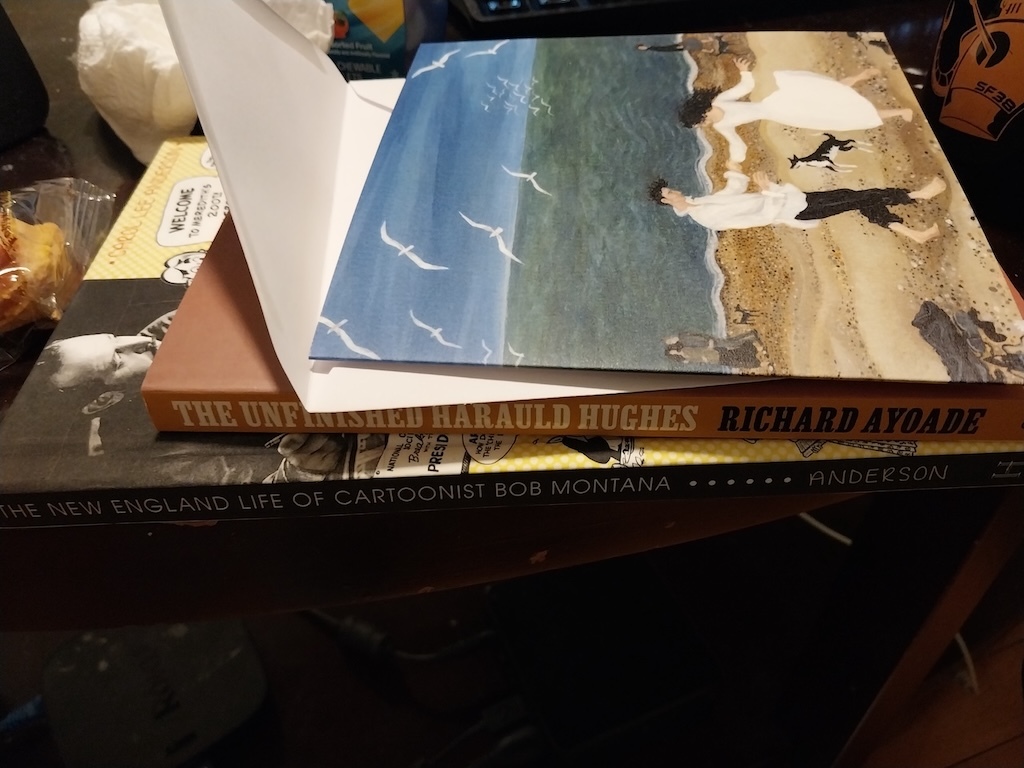
I have written another fill (AO3) for
threesentenceficathon. WERS played Dave Herlihy's "Good Trouble" (2025) and I had to get home to trace his voice to Boston's own post-punk O Positive. I wish I could call the hundred-year tides against the people who have no right to the streets of my grandparents' city. Failing that, it still matters to be alive.My plans to sleep out a recovery from Arisia were somewhat complicated by the move-in of the new upstairs neighbors and the resonating chamber of feet and furniture our bedroom immediately downstairs of this process necessarily turned into, but the snow remains beautifully fallen and is not even supposed to rain back into immediate slush or, worse, spring.
I am re-reading Kathryn M. Drennan's To Dream in the City of Sorrows (1997) for the first time since it came out and had completely forgotten the introduction by J. Michael Straczynski in which he designates it the first fully canonical novel in the Babylon 5 tie-in line. Despite the volumes of Harlan Ellison I was tracking down in used book stores and reading at the time—his credit as creative consultant was a point in the show's favor—it was not until years later that I caught since how much of his nonfiction voice had been adopted by JMS. "How difficult a task was this? Job would've packed it in, Hercules would've retired, and Orpheus would've decided that his days spent in Hades weren't really that bad."
The Post-Meridian Radio Players have now opened auditions for their spring show: Jeeves & Wooster: Hijinks and Shenanigans. I am seriously considering throwing myself on a slot for the genderswapped adaptation. It would be something of an exercise if I went for it; most of my performance skills do not translate into straight acting and I am frankly missing the facility with accents specified in the sides or I'd be able to code-switch out of being asked all the time where mine's really from. There was an intrusion here from Tiny Wittgenstein which has since been deleted. But even if it's just the hangover from Arisia, I have not auditioned for anything since 2019 and so long as I could decouple the experience from actually landing a part, it suddenly looked as though it might be fun.
Indeed, I had never heard of hickory oil. I am not however thrilled by the prospect of trading off maple syrup.
I am re-reading Kathryn M. Drennan's To Dream in the City of Sorrows (1997) for the first time since it came out and had completely forgotten the introduction by J. Michael Straczynski in which he designates it the first fully canonical novel in the Babylon 5 tie-in line. Despite the volumes of Harlan Ellison I was tracking down in used book stores and reading at the time—his credit as creative consultant was a point in the show's favor—it was not until years later that I caught since how much of his nonfiction voice had been adopted by JMS. "How difficult a task was this? Job would've packed it in, Hercules would've retired, and Orpheus would've decided that his days spent in Hades weren't really that bad."
The Post-Meridian Radio Players have now opened auditions for their spring show: Jeeves & Wooster: Hijinks and Shenanigans. I am seriously considering throwing myself on a slot for the genderswapped adaptation. It would be something of an exercise if I went for it; most of my performance skills do not translate into straight acting and I am frankly missing the facility with accents specified in the sides or I'd be able to code-switch out of being asked all the time where mine's really from. There was an intrusion here from Tiny Wittgenstein which has since been deleted. But even if it's just the hangover from Arisia, I have not auditioned for anything since 2019 and so long as I could decouple the experience from actually landing a part, it suddenly looked as though it might be fun.
Indeed, I had never heard of hickory oil. I am not however thrilled by the prospect of trading off maple syrup.
Tonight after my second and last panel of the convention, I was told by one audience member that they would listen to me read the phone book because even under those circumstances they would learn something interesting and Tiny Wittgenstein was definitely confused.
The panels went chaotically well. "Cursed Literature" lived up to its name by losing two panelists before the con even started, but in practice it turned into a freewheeling discussion less of literature in particular than the concepts of hazardous information, the spellmaking of language, and narratives as contagion, which gave me an excuse to boost Emeric Pressburger's The Glass Pearls (1966), An-sky's Jewish Ethnographic Program of 1912–14, and Aramaic incantation bowls plus the inevitable M. R. James. "SFF on Stage" had a supersaturation of panelists mostly from the performing arts and could have gone an extra hour at least as we started with the inherently liminal nature of theater and bounced around through all the ways that the speculative can be invoked on stage through conceits, stagecraft, scoring, nothing but the contract that reality changes because the actor says it does. I went all in on twentieth-century opera and weird technically realist plays and discovered that there has actually not been another production of Jewelle Gomez's Bones & Ash: A Gilda Story since the one I saw with my grandparents in 1996. As always, members of the audience asked such good questions that they should have been on the panels to start.
I have been asked multiple times if I will be around for the last day of Arisia and since I have no further programming the odds are unfortunately good that I will be flat in bed, but at the moment I regret nothing. I saw agenarti! I saw a skygiants! I failed to write down the names of a pair of extraordinarily well-dressed attendees who wanted to talk about Jewish folk magic and were thrilled that I recognized their Babylon 5 tie-in novels! nineweaving and I shared a panel for the first time since virtual 2021! I did not make it back to the dealer's room before it closed and instead sort of keeled over in the disused cosplay repair area with choco_frosh and presently a friend of his who is unlikely to be on DW, since this time around people were giving me their contact information on Instagram and I felt as though I should have business cards printed on papyrus scraps. I had genuinely not been sure how this experiment in professional interaction would go. It is snowing as busily as a real winter in New England and without begrudging a second of this vanishing season, I am looking forward to Readercon.
The panels went chaotically well. "Cursed Literature" lived up to its name by losing two panelists before the con even started, but in practice it turned into a freewheeling discussion less of literature in particular than the concepts of hazardous information, the spellmaking of language, and narratives as contagion, which gave me an excuse to boost Emeric Pressburger's The Glass Pearls (1966), An-sky's Jewish Ethnographic Program of 1912–14, and Aramaic incantation bowls plus the inevitable M. R. James. "SFF on Stage" had a supersaturation of panelists mostly from the performing arts and could have gone an extra hour at least as we started with the inherently liminal nature of theater and bounced around through all the ways that the speculative can be invoked on stage through conceits, stagecraft, scoring, nothing but the contract that reality changes because the actor says it does. I went all in on twentieth-century opera and weird technically realist plays and discovered that there has actually not been another production of Jewelle Gomez's Bones & Ash: A Gilda Story since the one I saw with my grandparents in 1996. As always, members of the audience asked such good questions that they should have been on the panels to start.
I have been asked multiple times if I will be around for the last day of Arisia and since I have no further programming the odds are unfortunately good that I will be flat in bed, but at the moment I regret nothing. I saw a
genarti! I saw a skygiants! I failed to write down the names of a pair of extraordinarily well-dressed attendees who wanted to talk about Jewish folk magic and were thrilled that I recognized their Babylon 5 tie-in novels! nineweaving and I shared a panel for the first time since virtual 2021! I did not make it back to the dealer's room before it closed and instead sort of keeled over in the disused cosplay repair area with choco_frosh and presently a friend of his who is unlikely to be on DW, since this time around people were giving me their contact information on Instagram and I felt as though I should have business cards printed on papyrus scraps. I had genuinely not been sure how this experiment in professional interaction would go. It is snowing as busily as a real winter in New England and without begrudging a second of this vanishing season, I am looking forward to Readercon.I may feel like a dishrag, but if so it's a dishrag who had a wonderful time returning to Arisia after six years, even if the ziggurat on the Charles is still a dreadful place to hold a convention. For the Dramatic Readings from the Ig Nobel Prizes, I performed selections from W. C. Meecham and H. G. Smith's "Effects of Jet Aircraft on Mental Hospital Admissions" (British Journal of Audiology, 1977) with what I hope was an appropriately haggard channeling of my sleepless night and Leonie Cornips' "The semiotic repertoire of dairy cows" (Language in Society, 2024) with what I hope was an appropriately technical rendition of cow noises. I heard papers on the proper techniques of nose-blowing, whether snakes dress to the left or the right, the sexual correlations of apples. It feels impossible, but it must have been my first time onstage since onset of pandemic. Readers who overstayed their allotted two minutes were surrounded by a chorus of bananas.
I had forgotten how much socializing my attendance of conventions used to entail. I turned the corner for registration and immediately spotted anineweaving, followed in close succession by a choco_frosh, a_reasonable_man, and a sorcyress. I was talking to the latter in the coat check when Gillian Daniels came in and now I have a zine-printed copy of the second edition of her chapbook Eat the Children (2019/2026). I had not lengthy enough catch-up conversations with awhyzip and rinue and am now in possession of a signed copy of Nothing in the Basement (2025). I brought water with me and kept forgetting to duck outside to drink it. Dean gave me a ride home afterward and commented on my tired look, which was fair: six, seven years ago I could sprint through programming even after a night of anaphylaxis or a subluxed jaw and these days there's a lot less tolerance in the system. It seemed to be a common refrain. If I have fun and don't take home any viral infections from this weekend, it'll be a win.
Tomorrow, panels.
I had forgotten how much socializing my attendance of conventions used to entail. I turned the corner for registration and immediately spotted a
nineweaving, followed in close succession by a choco_frosh, a_reasonable_man, and a sorcyress. I was talking to the latter in the coat check when Gillian Daniels came in and now I have a zine-printed copy of the second edition of her chapbook Eat the Children (2019/2026). I had not lengthy enough catch-up conversations with awhyzip and rinue and am now in possession of a signed copy of Nothing in the Basement (2025). I brought water with me and kept forgetting to duck outside to drink it. Dean gave me a ride home afterward and commented on my tired look, which was fair: six, seven years ago I could sprint through programming even after a night of anaphylaxis or a subluxed jaw and these days there's a lot less tolerance in the system. It seemed to be a common refrain. If I have fun and don't take home any viral infections from this weekend, it'll be a win.Tomorrow, panels.
Alexander Knox was born on this date a hundred and nineteen years ago and without him I might never have discovered that the fan magazines of classical Hollywood could get as specifically thirsty as the modern internet.
Come to that, you would have been pretty tasty in the pulpit, too, Alex. You look, except for that glint in your eyes and that dimple in your cheek, like a minister's son. You look serious, even studious. You dress quietly, in grays and blacks and browns. Your interests are in bookish things. You live in a furnished apartment on the Strip in Hollywood, and have few possessions. You like to "travel light," you said so. You like to move about a lot, always have and always will. You've lived in a trunk for so many years you are, you explained, used to it. Of course, you've been married twice, which rather confuses the issue. But perhaps two can travel as lightly as one, if they put their minds to it. But you do have books. You have libraries in three places. At home, in Canada. At the farm in Connecticut, of which you are part owner, and in the apartment where you and your bride Doris Nolan still live. You write, which would come in handy with sermons. You're dreamy when you play the piano. For the most part it isn't, let's face it, church music you play. But you could convert.
—Gladys Hall, "Memo to Alex Knox" (Screenland, August 1945)
Come to that, you would have been pretty tasty in the pulpit, too, Alex. You look, except for that glint in your eyes and that dimple in your cheek, like a minister's son. You look serious, even studious. You dress quietly, in grays and blacks and browns. Your interests are in bookish things. You live in a furnished apartment on the Strip in Hollywood, and have few possessions. You like to "travel light," you said so. You like to move about a lot, always have and always will. You've lived in a trunk for so many years you are, you explained, used to it. Of course, you've been married twice, which rather confuses the issue. But perhaps two can travel as lightly as one, if they put their minds to it. But you do have books. You have libraries in three places. At home, in Canada. At the farm in Connecticut, of which you are part owner, and in the apartment where you and your bride Doris Nolan still live. You write, which would come in handy with sermons. You're dreamy when you play the piano. For the most part it isn't, let's face it, church music you play. But you could convert.
—Gladys Hall, "Memo to Alex Knox" (Screenland, August 1945)
Today was the yahrzeit of the molasses flood. I was last at Langone Park for the centenary, since which time the field has been renovated and a new marker erected in memory of the disaster and its dead. Seven years ago feels nearly a century itself.
Speaking of man-made needless awfulness, I have been made aware of the locally vetted aggregate of Stand with Minnesota, a directory of mutual aid, fundraisers, and on-the-ground support against the onslaught of ICE. All could use donations, since internet hugs are of limited efficacy against tear gas, batons, bullets to the face and legs. Twenty-three years ago feels like several worldlines back, but the Department of Homeland Security sounded absurdly, arrogantly dystopian then.
The fourth and last of this week's doctors' appointments concluded with an inhaler and instructions to sleep as much as possible. My ability to watch movies remains on some kind of mental fritz which upsets me, but I liked running across these poems.
Speaking of man-made needless awfulness, I have been made aware of the locally vetted aggregate of Stand with Minnesota, a directory of mutual aid, fundraisers, and on-the-ground support against the onslaught of ICE. All could use donations, since internet hugs are of limited efficacy against tear gas, batons, bullets to the face and legs. Twenty-three years ago feels like several worldlines back, but the Department of Homeland Security sounded absurdly, arrogantly dystopian then.
The fourth and last of this week's doctors' appointments concluded with an inhaler and instructions to sleep as much as possible. My ability to watch movies remains on some kind of mental fritz which upsets me, but I liked running across these poems.
My schedule for Arisia this year is minute, but a fairly big deal for me since the state of my health last allowed me to participate in programming in 2021. I mean, at the moment the state of my health is failed, but I'm still looking forward.
Dramatic Readings from the Ig Nobel Prizes
Saturday 3 pm, Amesbury AB
Marc Abrahams et al.
Highlights from Ig Nobel prize-winning studies and patents, presented in dramatic mini-readings by luminaries and experts (in some field). The audience will have an opportunity to ask questions about the research presented—answers will be based on the expertise of the presenters, who may have a different expertise than the researchers.
Cursed Literature
Sunday 4:15 pm, Central Square
Mark Millman (m), Alastor, Kristina Spinney, Sonya Taaffe
Some literature describes haunted houses; other books seem like they are haunted, as though the act of reading the book is inviting something vaguely unclean into the reader's life. Whether considering the dire typographical labyrinths of The House of Leaves, or the slowly expanding void at the heart of Kathe Koja's Cypher, some works leave a mark. Panelists will explore books that by reputation or their own experience, produce a lingering unsettled feeling far beyond the events and characters of the story.
SFF on Stage
Sunday 5:30 pm, Porter Square B
Raven Stern (m), Andrea Hairston, Greer Gilman, Sonya Taaffe, Stephen R. Wilk
Science fiction and fantasy have long been mainstays of live theater; William Shakespeare wrote A Midsummer Night's Dream in 1595. Peter Pan introduced one of the 20th century's best known characters in 1904. In 1920, R.U.R. gave us the word "robot." Universal Studios' famous version of Dracula was adapted not from the novel, but the wildly successful Broadway play. That's not even getting into modern musicals like Wicked or Little Shop of Horrors. What does it take for genre to work in a live setting, and where have we seen it succeed (or fail)?
Anyone else I can expect to see this weekend? The ziggurat awaits.
Dramatic Readings from the Ig Nobel Prizes
Saturday 3 pm, Amesbury AB
Marc Abrahams et al.
Highlights from Ig Nobel prize-winning studies and patents, presented in dramatic mini-readings by luminaries and experts (in some field). The audience will have an opportunity to ask questions about the research presented—answers will be based on the expertise of the presenters, who may have a different expertise than the researchers.
Cursed Literature
Sunday 4:15 pm, Central Square
Mark Millman (m), Alastor, Kristina Spinney, Sonya Taaffe
Some literature describes haunted houses; other books seem like they are haunted, as though the act of reading the book is inviting something vaguely unclean into the reader's life. Whether considering the dire typographical labyrinths of The House of Leaves, or the slowly expanding void at the heart of Kathe Koja's Cypher, some works leave a mark. Panelists will explore books that by reputation or their own experience, produce a lingering unsettled feeling far beyond the events and characters of the story.
SFF on Stage
Sunday 5:30 pm, Porter Square B
Raven Stern (m), Andrea Hairston, Greer Gilman, Sonya Taaffe, Stephen R. Wilk
Science fiction and fantasy have long been mainstays of live theater; William Shakespeare wrote A Midsummer Night's Dream in 1595. Peter Pan introduced one of the 20th century's best known characters in 1904. In 1920, R.U.R. gave us the word "robot." Universal Studios' famous version of Dracula was adapted not from the novel, but the wildly successful Broadway play. That's not even getting into modern musicals like Wicked or Little Shop of Horrors. What does it take for genre to work in a live setting, and where have we seen it succeed (or fail)?
Anyone else I can expect to see this weekend? The ziggurat awaits.
Running this many days without sleep, I find it hard to tell whether I had an insight about creativity this weekend or just reinvented a 101-level objection to LLMs and so-called generative AI, but it ocurred to me that such technologies are not capable of allusions. Their algorithms are not freighted with the same three-dimensional architecture of associations which accrete around information stored in the human cold porridge, all the emotional colors and sensory overtones and contextual echoes which attend the classic example of a word like tree when you throw it out across the incommensurable void between one human mind and another to be plugged into their own idiosyncratically plastic linkage of bias and experience whose least incompatibility may be the difference between a bristlecone and a birch and Wittgenstein has to lie down with a headache, but all of these entanglements form as much of the texture of a writer's style—of any human communication—as the word cloud of their vocabulary or their most commonly diagrammed sentences. It has always interested me to be able to detect the half-rhymes or skeletons of familiarity in the work of other writers; I have always assumed I am reciprocally legible if not transparent from space. I've seen arguments against the creativity of LLMs based on intentionality, but the unintended encrustrations seem just as important to me. By way of illustration, this thought was partly sparked by this classic and glorious mashup.
I was delighted to find on checking the news this morning that a new Roman villa just dropped. Given the Iron Age hillforts, the twelfth-century abbey, the Georgian country house, and the CH station, Margam Country Park clearly needed a Roman find to complete the set. I have since been informed of the discovery of a similarly well-preserved and impressive carnyx. Goes shatteringly with a villa, the Iceni tell me.
I joke about this rock I spend most of my time under, but how can I never have heard of Marlow Moss? The Bryher vibes alone. The Constructivism. And a real short king, judging by that jaunty photo c. 1937 with Netty Nijhoff. Pursuing further details, I fell over Anton Prinner and have been demoralized about my comprehension of art history ever since.
Last night I read David Copperfield (1850) for the third time in my life. It has the terrible feel of a teachable moment. In high school I bounced almost completely off it. About ten years later, I enjoyed the dual-layered narration and was otherwise mostly engaged by the language. Now it appears I just like the novel, which I have to consider may be a factor of middle age. Or I had just read the necessary bunch more of Dickens in the interval, speaking of traceable reflections, recurring figures; my favorite character has not changed since eleventh grade, but I can see now the constellation he's part of. It seems improbable that I was always reading the novel while waiting for chorus to start, but I did get through Hardy's The Mayor of Casterbridge (1886) in the down time of a couple of rehearsals that year. I was not taking either of the standard literature classes, but I had friends who left their assigned reading lying around.
I have to be at three different doctors' offices tomorrow. I could be over this viral mishegos any second now.
I was delighted to find on checking the news this morning that a new Roman villa just dropped. Given the Iron Age hillforts, the twelfth-century abbey, the Georgian country house, and the CH station, Margam Country Park clearly needed a Roman find to complete the set. I have since been informed of the discovery of a similarly well-preserved and impressive carnyx. Goes shatteringly with a villa, the Iceni tell me.
I joke about this rock I spend most of my time under, but how can I never have heard of Marlow Moss? The Bryher vibes alone. The Constructivism. And a real short king, judging by that jaunty photo c. 1937 with Netty Nijhoff. Pursuing further details, I fell over Anton Prinner and have been demoralized about my comprehension of art history ever since.
Last night I read David Copperfield (1850) for the third time in my life. It has the terrible feel of a teachable moment. In high school I bounced almost completely off it. About ten years later, I enjoyed the dual-layered narration and was otherwise mostly engaged by the language. Now it appears I just like the novel, which I have to consider may be a factor of middle age. Or I had just read the necessary bunch more of Dickens in the interval, speaking of traceable reflections, recurring figures; my favorite character has not changed since eleventh grade, but I can see now the constellation he's part of. It seems improbable that I was always reading the novel while waiting for chorus to start, but I did get through Hardy's The Mayor of Casterbridge (1886) in the down time of a couple of rehearsals that year. I was not taking either of the standard literature classes, but I had friends who left their assigned reading lying around.
I have to be at three different doctors' offices tomorrow. I could be over this viral mishegos any second now.
The best thing about a photo I found tonight of John Vickery in 1981 is not that it headcanoned itself instantly as an image of the younger Neroon, it's that I had just been watching him in an American Theatre Wing seminar from that same year and been struck by how little of his older self in or out of character was immediately traceable in his thin collegiate face and especially his light Californian voice and so when looking out of mildly feverish curiosity for his notices that summer as Prince Hal I was really not expecting to find through nothing but chiaroscuro and expression his future Minbari bones.

Offstage, he had reminded me more of Kyle MacLachlan and barely looked old enough to have the bachelor's in mathematics which was part of his origin story. He tells it again in another seminar in 1998 and still has a nervous gesture of touching one of his eyes as if tired or distracted slightly; he's a great fidgeter in front of an off-the-cuff audience. I had gone looking originally for his voice, which turns out not even to be that mid-Atlantic when he's using it for himself. Three decades plus I had to notice this actor with my brain on perpetual standby for B5 and now it has an opinion.
To keep on the theme of theater, I had no idea until her obituary that Tina Packer started her career in the three-quarters burninated 1966 BBC David Copperfield with Ian McKellen and then the much more successfully recovered 1968 Doctor Who: The Web of Fear before she discovered she cared much less for acting than directing or producing, whence Shakespeare & Company. The last time I saw Hugh Whitemore's Breaking the Code was in 2011 at Central Square Theater and they are reviving it this spring with the actor I last saw as Gaveston in the ASP's Edward II in 2017, whom I expect to be a superb Turing and me to leave the theater muttering about Joan Clarke as usual. In lieu of a teleporter, I have to hope for a transfer of this High Noon.

Offstage, he had reminded me more of Kyle MacLachlan and barely looked old enough to have the bachelor's in mathematics which was part of his origin story. He tells it again in another seminar in 1998 and still has a nervous gesture of touching one of his eyes as if tired or distracted slightly; he's a great fidgeter in front of an off-the-cuff audience. I had gone looking originally for his voice, which turns out not even to be that mid-Atlantic when he's using it for himself. Three decades plus I had to notice this actor with my brain on perpetual standby for B5 and now it has an opinion.
To keep on the theme of theater, I had no idea until her obituary that Tina Packer started her career in the three-quarters burninated 1966 BBC David Copperfield with Ian McKellen and then the much more successfully recovered 1968 Doctor Who: The Web of Fear before she discovered she cared much less for acting than directing or producing, whence Shakespeare & Company. The last time I saw Hugh Whitemore's Breaking the Code was in 2011 at Central Square Theater and they are reviving it this spring with the actor I last saw as Gaveston in the ASP's Edward II in 2017, whom I expect to be a superb Turing and me to leave the theater muttering about Joan Clarke as usual. In lieu of a teleporter, I have to hope for a transfer of this High Noon.
While we seem to have skipped actual plague, all of my households have acquired the going lurgi and my head feels like a balloon which has been filled with concrete and may at any second fall off. I have not been ill with a pharmacologically suppressed immune system before. I hadn't been sure it would be capable of running even a low-grade fever.
I have him so totally identified with the role of Neroon on Babylon 5 (1994–98), I keep forgetting that John Vickery in common with many actors who could handle the hours of makeup made several appearances on Star Trek, although the time I actually seem to have seen him in that universe involved no enhancements beyond near-catatonic terror as the sole survivor of a creepily derelict death-ship in TNG's "Night Terrors" (1991). Perhaps it was just lost to the sands of fanzines, but I was genuinely surprised that no one on AO3 ever filled in some kind of comfort for a character who spends nearly his total screen time telepathically looping through cryptically traumatized echoes and crying. Just when you think you have a handle on other people's id.
It is not reasonable that for two years the earth has been bereft of a rust-black little cat with cut-lime eyes, my miracle, my salty boy, my sassafras, while it suffers the weight of human people who are not worth one of his twenty-six claws, snagged in my bathrobe as he clambered to my shoulder for his terrycloth time after a shower. I miss turning back the covers in this weather to find his sincere blink up from the bedclothes, the absolute trust in the soft curl of his back that no one would shift him from his burrowed comfort. I miss the notes in his purr, from the musical edge of wanting to the subterranean roar of contentment, the whole architecture of his body vibrating like throat singing with the little whiffle that went in and out of his voice, his signature trill. I miss the unretractable click of his claws that announced his progress and the calluses of his desert-rose pads with which he gripped fiercely for human touch. From childhood I was taught that cats turn into flowers and Autolycus lies with his grave goods at the roots of the forsythia I have twice watched bloom since his death; the candle lit for him after sunset burns and his sister did not spring immediately off the bed when I stumbled into it, nauseated and head-aching. I am not without cat in my life. But I am without this cat and he was of inestimable worth to the world.
I have him so totally identified with the role of Neroon on Babylon 5 (1994–98), I keep forgetting that John Vickery in common with many actors who could handle the hours of makeup made several appearances on Star Trek, although the time I actually seem to have seen him in that universe involved no enhancements beyond near-catatonic terror as the sole survivor of a creepily derelict death-ship in TNG's "Night Terrors" (1991). Perhaps it was just lost to the sands of fanzines, but I was genuinely surprised that no one on AO3 ever filled in some kind of comfort for a character who spends nearly his total screen time telepathically looping through cryptically traumatized echoes and crying. Just when you think you have a handle on other people's id.
It is not reasonable that for two years the earth has been bereft of a rust-black little cat with cut-lime eyes, my miracle, my salty boy, my sassafras, while it suffers the weight of human people who are not worth one of his twenty-six claws, snagged in my bathrobe as he clambered to my shoulder for his terrycloth time after a shower. I miss turning back the covers in this weather to find his sincere blink up from the bedclothes, the absolute trust in the soft curl of his back that no one would shift him from his burrowed comfort. I miss the notes in his purr, from the musical edge of wanting to the subterranean roar of contentment, the whole architecture of his body vibrating like throat singing with the little whiffle that went in and out of his voice, his signature trill. I miss the unretractable click of his claws that announced his progress and the calluses of his desert-rose pads with which he gripped fiercely for human touch. From childhood I was taught that cats turn into flowers and Autolycus lies with his grave goods at the roots of the forsythia I have twice watched bloom since his death; the candle lit for him after sunset burns and his sister did not spring immediately off the bed when I stumbled into it, nauseated and head-aching. I am not without cat in my life. But I am without this cat and he was of inestimable worth to the world.
Now that we are back in the swing of the year, my days are marked by doctors' appointments. I preferred being outside the calendar. I did dream briefly and unexpectedly of Alexander Knox, playing one of those harrowed, abrasive, obdurate figures on the other side of some internment or imprisonment that made me think he would have been anachronistically great as E. T. C. Werner. Have some link-like things.
1. John Heffernan falls into the category of actors of whom I have somehow become very fond without actually seeing all that much of them, which normally happens with character faces in the '40's. I am unlikely even to see his latest project, the freshly announced Amazon TV version of Tomb Raider, but since his character is described in the promotional dramatis personae as "an exhausted government official who finds himself tangled up in Lara's unusual world," it's nice to know I would almost certainly develop a disproportionate attachment to him if I had the chance. You can tell I am otherwise a solid generation of actors behind the times since I was impressed by the casting all in the same place of Jason Isaacs, Bill Paterson, Celia Imrie, Paterson Joseph, and Sigourney Weaver.
2. This song transfixed me a few nights ago on WHRB: Barbez, "Strange" (2005).
3. I meant once again to praise the Malden Public Library for ordering me a sun-bleached, peach-orange, jacketless first edition of Leslie Howard's Trivial Fond Records (ed. Ronald Howard, 1982), about whose selected nonfiction I have been intensely curious since discovering its existence in 2008, but the problem with reading some of the broadcasts he made for J. B. Priestley's Britain Speaks in 1940 is that one runs into passages like:
Democracy today, to survive at all, must be as militant as autocracy, and what the world is desperately in need of now is not the gentle, philosophic democracy of Jefferson, but the outspoken, militant and ringing democracy of Roosevelt, representing the righteous anger of the free people of the world aroused against the cynical arrogance of the totalitarian feudalists.
1. John Heffernan falls into the category of actors of whom I have somehow become very fond without actually seeing all that much of them, which normally happens with character faces in the '40's. I am unlikely even to see his latest project, the freshly announced Amazon TV version of Tomb Raider, but since his character is described in the promotional dramatis personae as "an exhausted government official who finds himself tangled up in Lara's unusual world," it's nice to know I would almost certainly develop a disproportionate attachment to him if I had the chance. You can tell I am otherwise a solid generation of actors behind the times since I was impressed by the casting all in the same place of Jason Isaacs, Bill Paterson, Celia Imrie, Paterson Joseph, and Sigourney Weaver.
2. This song transfixed me a few nights ago on WHRB: Barbez, "Strange" (2005).
3. I meant once again to praise the Malden Public Library for ordering me a sun-bleached, peach-orange, jacketless first edition of Leslie Howard's Trivial Fond Records (ed. Ronald Howard, 1982), about whose selected nonfiction I have been intensely curious since discovering its existence in 2008, but the problem with reading some of the broadcasts he made for J. B. Priestley's Britain Speaks in 1940 is that one runs into passages like:
Democracy today, to survive at all, must be as militant as autocracy, and what the world is desperately in need of now is not the gentle, philosophic democracy of Jefferson, but the outspoken, militant and ringing democracy of Roosevelt, representing the righteous anger of the free people of the world aroused against the cynical arrogance of the totalitarian feudalists.
Doubtful as it may be under present conditions to find encouragement in anything of military origin unless it's the USS Princeton in 1844, about twenty-seven seconds into the two minutes' patriotism of Warship Week Appeal (1942) I cracked up.
Two hundred feet exactly of no-credits 35 mm, the object in question is a trailer produced for the Ministry of Information, essentially the same concept as the film tags of WWI: a micro-dose of propaganda appended to a newsreel as part of a larger campaign, in this case a sort of public information skit in which it is supposed that Noël Coward on the Denham sets of In Which We Serve (1942) is approached by Leslie Howard, slouching characteristically on with his hands in his pockets and his scarf twisted carelessly label-out, anxious to discuss a problem of National Savings. "How do you think we can make an appeal so it won't quite seem like an appeal?" With limited screen time to realize their meta conceit, the two actor-directors get briskly down to explaining the mechanics of the scheme to the British public with the shot-reverse-shot patter of a double act on the halls, but the trailer has already dropped its most memorable moment ahead of all its instructions and slogans, even its brief mnemonic rhyme. Diffident as one end of his spectrum of nerd heroes, Howard apologizes for the interruption, excuses it with its relevance to naval business, and trails off with the usual form of words, "I'm sure you won't mind—" to which Coward responds smoothly, "I'm delighted to see you. And I know perfectly well—as we rehearsed it so carefully—that you've come to interview me about Warships Week." He doesn't even bother to hold for a laugh as Leslie snorts around his unlit cigarette. It really does not feel like a bit. The interjection may or may not have been scripted, but Coward's delivery is lethally demure and his scene partner's reaction looks genuine; for one, it's much less well-timed or dignified than the smile he uses to support a later, slightly obligatory joke about the income tax, which makes it that much more endearing. It's funny to me for a slant, secondhand reason, too, that has nothing to do with the long friendship between the two men or further proof of Noël's deadpan for the ages: a dancer with whom my mother once worked had been part of the company of Howard's 1936 Hamlet and like all the other small parts, whenever her back was to the audience and the Hollywood star was stuck facing the footlights, she did her best to corpse him. One night she finally succeeded. Consequently and disproportionately, watching him need the length of a cigarette-lighting to get his face back, I thought of her story which I hadn't in years and may have laughed harder than Leslie Howard deserved. If it's any consolation to him, the way his eyes close right up like a cat's is beautiful, middle-aged and underslept. It promotes the illusion that a real person might say a phrase like "in these grim days when we've got our backs to the wall" outside of an address to the nation.
Not as much consolation to the MOI, Warship Week Appeal accomplishes its goal in that while it doesn't mention for posterity that a community would adopt the ship it funded, the general idea of the dearth of "ships—more ships and still more ships" and the communal need to pay down for them as efficiently as possible comes through emphatically. It's so much more straightforward, in fact, than I associate with either of its differently masked actors, I'd love to know who wrote it, but the only other information immediately available is that the "Ronnie" whom Coward is conferring with when Howard courteously butts in is Ronald Neame. Given the production dates of their respective pictures, it's not difficult to pretend that Howard just popped over from the next sound stage where he was still shooting The First of the Few (1942), although he is clearly in star rather than director mode because even if he's in working clothes, he is conspicuously minus his glasses. What can I tell you? I got it from the Imperial War Museum and for two minutes and thirteen seconds it cheered me up. Lots of things to look at these days could do much, much worse. This interview brought to you by my appealing backers at Patreon.
Two hundred feet exactly of no-credits 35 mm, the object in question is a trailer produced for the Ministry of Information, essentially the same concept as the film tags of WWI: a micro-dose of propaganda appended to a newsreel as part of a larger campaign, in this case a sort of public information skit in which it is supposed that Noël Coward on the Denham sets of In Which We Serve (1942) is approached by Leslie Howard, slouching characteristically on with his hands in his pockets and his scarf twisted carelessly label-out, anxious to discuss a problem of National Savings. "How do you think we can make an appeal so it won't quite seem like an appeal?" With limited screen time to realize their meta conceit, the two actor-directors get briskly down to explaining the mechanics of the scheme to the British public with the shot-reverse-shot patter of a double act on the halls, but the trailer has already dropped its most memorable moment ahead of all its instructions and slogans, even its brief mnemonic rhyme. Diffident as one end of his spectrum of nerd heroes, Howard apologizes for the interruption, excuses it with its relevance to naval business, and trails off with the usual form of words, "I'm sure you won't mind—" to which Coward responds smoothly, "I'm delighted to see you. And I know perfectly well—as we rehearsed it so carefully—that you've come to interview me about Warships Week." He doesn't even bother to hold for a laugh as Leslie snorts around his unlit cigarette. It really does not feel like a bit. The interjection may or may not have been scripted, but Coward's delivery is lethally demure and his scene partner's reaction looks genuine; for one, it's much less well-timed or dignified than the smile he uses to support a later, slightly obligatory joke about the income tax, which makes it that much more endearing. It's funny to me for a slant, secondhand reason, too, that has nothing to do with the long friendship between the two men or further proof of Noël's deadpan for the ages: a dancer with whom my mother once worked had been part of the company of Howard's 1936 Hamlet and like all the other small parts, whenever her back was to the audience and the Hollywood star was stuck facing the footlights, she did her best to corpse him. One night she finally succeeded. Consequently and disproportionately, watching him need the length of a cigarette-lighting to get his face back, I thought of her story which I hadn't in years and may have laughed harder than Leslie Howard deserved. If it's any consolation to him, the way his eyes close right up like a cat's is beautiful, middle-aged and underslept. It promotes the illusion that a real person might say a phrase like "in these grim days when we've got our backs to the wall" outside of an address to the nation.
Not as much consolation to the MOI, Warship Week Appeal accomplishes its goal in that while it doesn't mention for posterity that a community would adopt the ship it funded, the general idea of the dearth of "ships—more ships and still more ships" and the communal need to pay down for them as efficiently as possible comes through emphatically. It's so much more straightforward, in fact, than I associate with either of its differently masked actors, I'd love to know who wrote it, but the only other information immediately available is that the "Ronnie" whom Coward is conferring with when Howard courteously butts in is Ronald Neame. Given the production dates of their respective pictures, it's not difficult to pretend that Howard just popped over from the next sound stage where he was still shooting The First of the Few (1942), although he is clearly in star rather than director mode because even if he's in working clothes, he is conspicuously minus his glasses. What can I tell you? I got it from the Imperial War Museum and for two minutes and thirteen seconds it cheered me up. Lots of things to look at these days could do much, much worse. This interview brought to you by my appealing backers at Patreon.


