


The Starving Saints, by Caitlin Starling
2026-02-17 10:53![[personal profile]](https://www.dreamwidth.org/img/silk/identity/user.png) rachelmanija
rachelmanija
Excellent dark fantasy about three women trapped in a medieval castle under siege. It reminded me a bit of Tanith Lee - it's very lush and decadent in parts - and a bit of The Everlasting. Fantastic female characters with really interesting relationships. The language is not strictly medieval-accurate but a lot of the characters' mindsets are, which is fun.
All I knew going in was that it was medieval, female-centric, and involved cannibalism. This gave me a completely wrong impression, which was that it was a sort of female-centric medieval Lord of the Flies in which everyone turns on each other under pressure and starts killing and eating each other. This is very nearly the opposite of what it's actually about, though there is some survival-oriented eating of the already-dead.
The three main characters are Phosyne, an ex-nun and mad alchemist with some very unusual pets that even she has no idea what they are; Ser Voyne, a female knight whose rigid loyalty gets tested to hell and back; and Treila, a noblewoman fallen on hard times and desperate to escape. The three of them have deliciously complicated relationships with each other, fully of shifting boundaries, loyalties, trust, sexuality, and love.
At the start, everyone is absolutely desperate. They've been trapped in the castle under siege for six months, the last food will run out in two weeks, and help does not seem to be on the way. Treila is catching rats and plotting her escape via a secret tunnel, but some mysterious connection to Ser Voyne is keeping her from making a break for it. Phosyne has previously enacted a "miracle" to purify the water, and the king is pressuring her to miraculously produce food; unfortunately, she has no idea how she did the first miracle, let alone how to conjure food out of nothing. Ser Voyne, who wants to charge out and fight, has been assigned to stand over Phosyne and make her do a miracle.
And then everything changes.
The setting is a somewhat alternate medieval Europe; it's hard to tell exactly how alternate because we're very tightly in the POV of the three main characters, and we only know what they're directly observing or thinking about. The religion we see focuses on the Constant Lady and her saints. She might be some version of the Virgin Mary, but though the language around her is Christian-derived, there doesn't seem to be a Jesus analogue. The nuns (no priests are ever mentioned) keep bees and give a kind of Communion with honey. Some of them are alchemists and engineers. There is a female knight who is treated differently than the male knights by the king and there's only one of her, but it's not clear whether this is specific to their relationship or whether women are usually not allowed to be knights or whether they are allowed but it's unusual.
This level of uncertainty about the background doesn't feel like the author didn't bother to think it out, but rather adds to the overall themes of the book, which heavily focus on how different people experience/perceive things differently. It also adds to the claustrophobic feeling: everyone is trapped in a very small space and additionally limited by what they can perceive. The magic in the book does have some level of rules, but is generally not well understood or beyond human comprehension. There's a pervasive sense of living in a world that isn't or cannot be understood, but which can only be survived by achieving some level of comprehension.
And that's all you should know before you start. The actual premise doesn't happen until about a fourth of the way into the book, and while it's spoiled in all descriptions I didn't know it and really enjoyed finding out.
Spoilers for the premise. ( Read more... )
Spoilers for later in the book: ( Read more... )
Probably the last third could have been trimmed a bit, but overall this book is fantastic. I was impressed enough that I bought all of Starling's other books for my shop. I previously only had The Luminous Dead, which I'm reading now.
Content notes: Cannibalism. Physical injury/mutilation. Mind control. A dubcon kiss. Extremely vivid descriptions of the physical sensations of hunger and starvation. Phosyne's pets do NOT die!
Feel free to put spoilers for the whole book in comments.

and yet... (I miss my mother)
2026-02-17 09:59lauradi7dwJesse Jackson ran for president twice, in 1984 and 1988, during the Reagan years. I remember a conversation in my grandmother's kitchen, with my grandmother saying that she didn't think Jackson should be president. I remarked that people were suggesting that he should be the "drug czar." My mother said she thought he would do a good job. It didn't happen. Probably nobody would actually have done a good job at that goofy post, part of the Reagans' (plural) useless drug policy.
Doing tax prep, I have also been thinking of my mother. My parents paid an accountant a lot of money to prepare their taxes, but they were required to fill in a workbook with any/all relevant information. I felt that they were doing most of the work, but they were never audited, so he must have copied the info into the right slots, at least. When my mother became too tired to do all the prep and turned it over to me, she said "you need to buy some yellow legal pads." This had been her go-to for doing all the lists and calculations before submitting the workbook. I told her that I would do all the listing and calculations on Open Office documents instead. I type much better than I write, for one thing. But as I was starting to work on my taxes this year, I wandered into what used to be Arthur's office without thinking, looking for a legal pad on a shelf. That bookshelf is gone. I looked around vaguely and didn't find a yellow legal pad anywhere else. Do I have (now Libre) office documents and spreadsheets to use? Yes, but I also am writing some things in a (white, spiral-bound) notebook. I misuse the title of Nancy Friday's 1977 book "My Mother, Myself" fairly often, but here I am again, doing it.
composed in my head, will I type and include photos?
2026-02-17 08:39lauradi7dwLunar new year
Cuba
paradancing teams
not para teams doing very pointed dances about ICE in DC locations
Switzerland - neutral or not? Political commentary during Olympics, vs CBS trying to silence Colbert again in other political news
Lots of other people will presumably post about Robert Duvall and Jesse Jackson, so they aren't on my list.
Book Review: All the Blues in the Sky
2026-02-17 08:01osprey_archerThere is probably someone, someone, who could make me enjoy a Book in Verse about Death, but unfortunate Watson is not that person, or at least this book is not that book.
Our heroine is Sage, who recently lost her best friend when she was hit by a drunk driver while walking to Sage’s house for Sage’s birthday. Sage is now part of the grief group at school, where she sits inwardly sneering at the two members who lost people after a long illness (a grandmother to dementia, and a twin sister to leukemia), because THEY don’t know what it’s like to lose someone unexpectedly.
And, you know, technically this is true. But one feels that at some point someone should point out to Sage that she doesn’t know what it’s like to live in the Valley of the Shadow of Death for years, watching a loved one slowly wither away.
And okay fine, Sage’s Aunt Ini does eventually point out that everyone grieves differently and you can’t directly compare grief etc etc. However, there’s a scene where Sage screams at these girls that they don’t understand anything, and I really, really wanted one of them to scream back that they might not understand her grief but at least they’re TRYING, unlike Sage who very obviously doesn’t give a damn about them. Like, her disdain is so obvious that the other members of Grief Group (the ones who also lost people unexpectedly and are therefore acceptable to Sage) comment that Sage doesn’t like the girls whose relatives died long, slow, agonizing deaths, and Sage responds that it’s because they “don’t know how good they had it.”
But of course no one screams back at Sage. Of course when Sage apologizes, everyone accepts it, instead of telling her to stuff her apology where the sun don’t shine, or at least pointing out the fact that she blew up about how the others don’t understand her pain when she hasn’t been trying even slightly to understand theirs.
And then! And then! ( spoilers for the ending )
Family Comes First
2026-02-17 09:52poliphiloEvery family is potentially a criminal enterprise. This hold good of families at every level of society, from the Hapsburgs in their palaces to the Krays in their East End "manor" to the Browns at number 17.
2026/022: Boy, With Accidental Dinosaur — Ian McDonald
2026-02-17 08:35tamaranth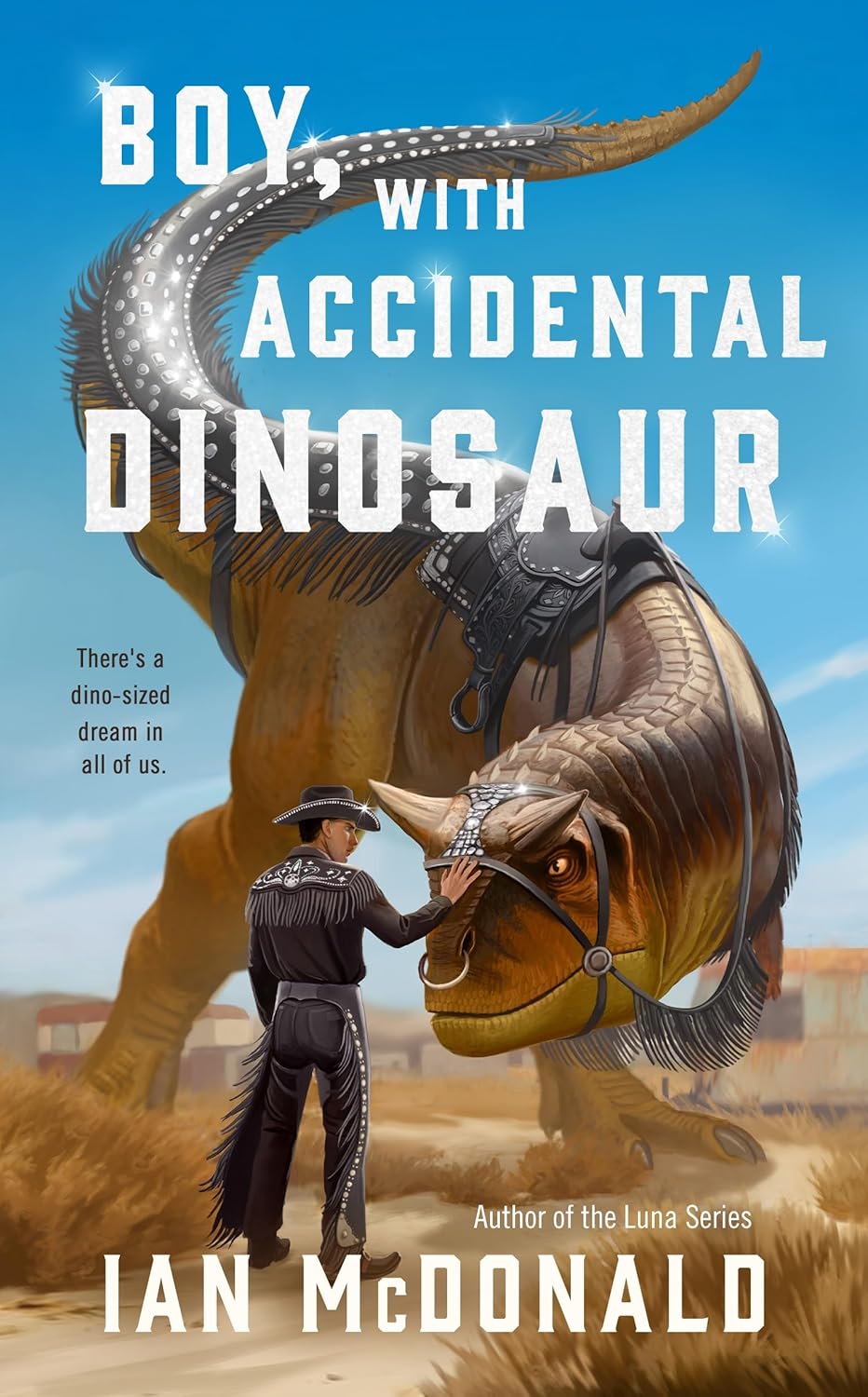
Under a high blue heaven, under the zealous sun, the kid and his dinosaur travel a hot, empty highway. [first line]
Tif (short for Latif) is an orphan of Arab descent, whose ambition is to become a buckaroo at one of the dino rodeos. The novella's opening presents him, with his dinosaur, on a journey: only gradually are we shown where he's going, and why -- and where he's come from.
This is the post-apocalyptic future of the country formerly known as the United States of America, now a dangerous wilderness of miliciano gangs, religious states, and aggressive Dominion raiders. Tif's parents were killed in the South Dakota purification. He's recently been sacked from Dino! Dino! after a Timursaur escaped and wreaked havoc.( Read more... )

music sorting again
2026-02-16 23:51thedarlingone( Read more... )
Okay, I went and cleared those out, plus some more duplicates I'm sure of (there are so many more duplicates I have to actually check by ear). That brings us down to 93 hours of music, of which I'm almost six hours in. It's nearly midnight here; I think I'll wrap it up and go to bed. Next on the list is two versions of Bridge Over Troubled Water, the Simon & Garfunkel version and a Johnny Cash cover.
Recent reading
2026-02-16 22:57troisoiseauxNot wishing to agree to Dolgorukov's demand to commence the action, and wishing to avert responsibility from himself, Prince Bagration proposed to Dolgorukov to send to inquire of the commander in chief. Bagration knew that as the distance between the two flanks was more than six miles, even if the messenger were not killed (which he very likely would be), and found the commander in chief (which would be very difficult), he would not be able to get back before evening.
The selected messenger ends up being Nikolai Rostov, who does not die (despite, among other incidents, finding himself directly in the path of a unit of hussars charging at full gallop, because of course he did) but does fumble the chance to meet his idol Emperor Alexander: "But as a youth in love trembles, is unnerved, and dares not utter the thoughts he has dreamed of for nights," he's too shy to approach him even though he literally has an excuse to do so?? On the other hand, Prince Andrei is personally taken prisoner by his hero, Napoleon, although at that point he's kind of over it, having had an ongoing near-death experience and an accompanying revelation about "the insignificance of greatness."
I ended up skipping ahead in Damon Runyon's Guys and Dolls and Other Writings to read "The Idyll of Miss Sarah Brown" (1933), which was the main basis for the musical Guys & Dolls— it turns out that in the original story, there's no bet over whether gambler Sky Masterson can convince "missionary doll" Sarah Brown to join him on a day trip to Havana; he just falls for her on sight, tries to woo her by winning a guy's soul in a craps game to build up her mission, and then she catches on and comes marching in to gamble for his soul, which really ought to have made it into the musical but I've decided is how they make up off-stage between "Marry the Man Today" and the finale. (On the other hand, Sky's father's warning about not taking a bet from guys who "show you a nice brand-new deck of cards on which the seal is never broken" and "offer to bet you that the jack of spades will jump out of this deck and squirt cider in your ear," because "as sure as you do you are going to get an ear full of cider," is wholesale Runyon.) I agree with
osprey_archer that someone really ought to write a crossover between Runyon's dim-witted gangsters and P.G. Wodehouse's dim-witted toffs, especially because the last few (as read in order) stories have in fact involved befriending random civilians: in one, a trio of American gangsters are hired to assassinate the king of a small European country, only to discover that the king is about six and really keen on Al Capone and baseball; in another, a group of tough guys running a ticket-scalping racket (maybe more surprised than I should have been to discover this was a thing since at least the 1930s??) adopt a nice little doll who got stood up at the Harvard vs. Yale football game, and learn to love the epic highs and lows of college football in the process.recent reading
2026-02-16 20:04isisShroud by Adrien Tchaikovsky - first-contact with a very alien alien species on the tidally-locked moon of a gas giant. Earth is (FRTDNEATJ*) uninhabitable, humans have diaspora'ed in spaceships under the iron rule of corporations who cynically consider only a person's value to the bottom line, and the Special Projects team of the Garveneer is evaluating what resources can be extracted from the moon nicknamed "Shroud" when disaster (of course) strikes. The middle 3/5 of the book is a bizarre roadtrip through a strange frozen hell, as an engineer and an administrator (both women) must navigate their escape pod to a place where they might be able to call for rescue.
When I'd just started this book I said that it reminded me of Alien Clay, and it really does have a lot in common with that book, especially since they are both expressions of Tchaikovsky's One Weird Theme, i.e. "How can we see Other as Person?" He hits the same beats as he does in that and other books that are expressions of that theme (for example, the exploratory overture that is interpreted as hostility, the completely different methods of accomplishing the same task) but if it's the sort of thing you like, you will like this sort of thing. It also reminded me a bit of Dragon's Egg by Robert L. Forward, in the sense that it starts with an environment which is the opposite of anything humans would expect to find life on, and reasons out from physics and chemistry what life might be like in that environment. Finally, it (weirdly) reminded me of Summer in Orcus by T. Kingfisher, because the narrator, Juna Ceelander, feels that she's the worst possible person for the job (of survival, in this case); the engineer has a perfect skill-set for repairing the pod and interpreting the data they receive, but she's an administrator, she can do everyone's job a little, even if she can't do anybody's job as well as they can. But it turns out that it's important that she can do everyone's job a little; and it's also important that she can talk to the engineer, and stroke her ego when she's despairing, and not mind taking the blame for something she didn't do if it helps the engineer stay on task, and that's very Summer.
I enjoyed this book quite a lot!
[*] for reasons that don't need exploring at this juncture
How I Killed Pluto and Why It Had It Coming by Mike Brown is what took me through most of the worst of my cold, as it's an easy-to-read micro-history-slash-memoir, which is one of my favorite nonfiction genres. Brown is the astronomer who discovered a number of objects in the Kuiper Belt, planetoids roughly the size of Pluto, which led to the inevitable question: are these all planets, too? If so, the solar system would have twelve or fifteen or more planets. If not - Pluto, as one of these objects, should not be considered a planet.
I really enjoyed the tour through the history of human discovery and conception of the solar system, and the development of astronomy in the late 20th and early 21st centuries. He manages to outline the important aspects of esoteric technical issues without getting bogged down in detail, so it's very accessible to non-scientists. Interwoven in this was his own story, the story of his career in astronomy but also his marriage and the birth of his daughter. It's an engaging, chatty book, and one must forgive him for side-stepping the central question of "so what the heck is a planet, anyway?"
Don't Stop the Carnival by Herman Wouk, which B had read a while back when he was on a Herman Wouk kick. I'd read Winds of War and War and Remembrance, and Marjorie Morningstar, but that was it, and I remembered he had said it reminded him a lot of our time in the Bahamas and Caribbean when we were living on our boat.
The best thing about this book is Wouk's sharp, funny writing - his paragraphs are things of beauty, his characters drawn crisply with description that always seems novel. The story itself is one disaster after another, as Norman Paperman, Broadway publicist, discovers that running a resort in paradise is, actually, hell. It's funny, but the kind of funny that you want to read peeking through your fingers, because you just feel so bad for the poor characters.
On the other hand, this book was published in 1965, and it shows. I don't think the racist, sexist, antisemitic, pro-colonization attitudes expressed by the various characters are Wouk's - he's Jewish, for one thing, and he's mostly making a point about these characters, and these attitudes. The homophobia, I'm not sure. But the book's steeped in -ism and -phobia, and I cringed a lot.
I enjoyed this book (for some value of "enjoy") right up until near the end, where a sudden shift in tone ruined everything.
Don't Stop the Spoilers
Two characters die unexpectedly; a minor character, and then a more major character, and everything goes from zany slapstick disasters ameliorated at the last minute to a somber reckoning in the ashes of last night's party. In this light, the ending feels jarring: the resort's problems are solved, the future looks rosy, and Norman realizes he is not cut out for life in Paradise and, selling the resort to another sucker, returns to the icy New York winter.Reflecting on it, I think this ending is a better ending than the glib alternative of the resort's problems are solved, the future looks rosy, and Norman raises a glass and looks forward to dealing with whatever Paradise throws at him in the future. But because everything has gone somber, it feels not like he's learned a lesson and acknowledged reality, but that he's had his face rubbed in horror and decided he can't cope. If he'd celebrated his success and then ruefully stepped away, it would be an act of strength, but he runs back home, defeated, and all his experience along the way seems pointless.
Generation Loss by Elizabeth Hand - I got this book in a fantasy book Humble Bundle, so I was expecting fantasy, which this is very much not. It's a psychological thriller, following the first-person narrator Cass Neary, a fucked-up, drugged-out, briefly brilliant photographer who has been sent by an old acquaintance to interview a reclusive photographer - one of Cass's heroes - on a Maine island.
I kept reading because the narrative voice is fabulous and incredibly seductive, even though the character is a terrible person who does terrible things in between slugs of Jack Daniels and gulps of stolen uppers. It feels very immersive, both in the sense of being immersed in the world of the novel's events and in the sense of being immersed in the perspective of a messed-up photographer. But overall it's not really the sort of book I typically read, and it's not something I'd recommend unless you're into this type of book.
(no subject)
2026-02-16 21:08sorcyressBut.
I spent the day with various groups of friends, and doing a bunch of knitting work and making things with my hands. And it feels very very good.
I'm happy for that. I hope you can also find things that make you happy.
~Sor
MOOP!
Music Monday: Two Rockin’ Videos
2026-02-16 18:43jesse_the_kThe singer and the band are all on roller skates performing Bend Your Knees by Henry Mansfield & Digital Velvet! It’s an NPR Tiny Desk contest entry. Lyrics on bandcamp, video on YouTube or…
( Stream it Here )
Thanks to clevermanka for sharing Fabulous, an absolute banger in both fashion and music from MEEK. Not work-safe since the chorus repeats “fucking” 42 times. Video on YouTube with accurate captions and lyrics in the description or …
( stream it here )
Rhysling long list nomination
2026-02-16 13:33gwynnegaThe Staircase in the Woods, by Chuck Wendig
2026-02-16 12:40rachelmanija
Five high school friends go on a camping trip and find a mysterious staircase in the woods. One of them climbs it and vanishes. Twenty years later, the staircase reappears, and they go to face it again.
I loved this premise and the cover. The staircase leading nowhere is spooky and beautiful, a weird melding of nature and civilization, so I was hoping for something that matched that vibe, like Annihilation or Revelator.
That was absolutely not what I got. The Staicase in the Woods is the misbegotten mutant child of It, King Sorrow, and Tumblr-speak. Every single character is insufferable. The teenagers are boring, and the adults are all the worst people you meet at parties. There are four men and one woman/nonbinary person, and she/they reads exactly like what MAGA thinks liberal women/trans people are like -- AuHD, blue hair, Tumblr-speak, angry, preachy, kinky sex etc. She/they says "My pronouns are she/them," then is only ever referred to as she and a woman. The staircase itself is barely in the story, where it leads is a letdown, and the ending combines the worst elements of being dumb and unresolved.
I got partway in and then skimmed because I was curious about the staircase and the vanished kid.
Angry spoilers for the whole book.
( Read more... )