


The land'll tell you that the story's burning
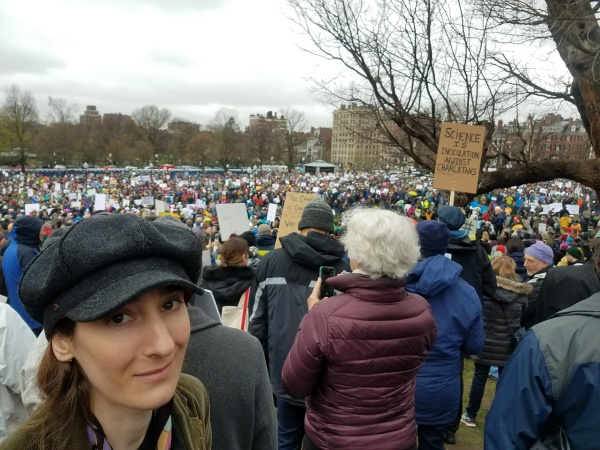
It was cold and raw and raining and I had slept three hours; it has been an exhausting week. I made it to the Boston March for Science and I am very glad I did. My father and I took the train from Alewife; walking back and forth in front of the fare machines we met a small child carrying "Less Invasions, More Equations!" (my brain yelled, "Fewer!" and I said, "Nice sign," because people who pedantically correct the protest signs of six-year-olds are not the kind of change I want to see in the world) and at Porter a contingent from the grad student employeee union of UMass got on with "Ignorance = √All Evil." Across the car from us a father was trying to explain Tom Lehrer to his daughter, resulting in a spontaneous chorus of "Pollution." When we got off at Park Street, it was a quarter to two and Boston Common was full of protesters and stalls and food trucks and kids' music from the bandstand and then we came up over the crest of the hill by the Soldiers and Sailors Monument and it was nerds with signs as far as the eye could see.
Eventually we worked our way down the mudslide to a point where we could hear the speakers from the main stage without getting blasted by the amplification. My father took pictures. Meeting up with Dean and Lily, I gave directions by the papier-mâché 45-on-a-stick with a separate sign for its speech bubble ("Believe me, climate change is a Chinese hoax! Sad!" while standing in a pants-on-fire flaming barrel of Exxon-Mobil) and held my blue butterfly-patterned umbrella aloft like a torch. I saw![[personal profile]](https://www.dreamwidth.org/img/silk/identity/user.png) gaudior and nineweaving and B. for about fifteen seconds before they disappeared with Fox, whose baby sling was pinned this time with a "Test Tube Baby" flag. We never did find choco_frosh and Peter. We had planned to stay the entire duration of the rally, but around a quarter to four the weather became just too cold to stand around in and we set off down Boylston Street in search of hot drinks, ending up at Patisserie on Newbury and then Trident Booksellers & Café. A great deal of walking later we met my mother in Porter Square.
gaudior and nineweaving and B. for about fifteen seconds before they disappeared with Fox, whose baby sling was pinned this time with a "Test Tube Baby" flag. We never did find choco_frosh and Peter. We had planned to stay the entire duration of the rally, but around a quarter to four the weather became just too cold to stand around in and we set off down Boylston Street in search of hot drinks, ending up at Patisserie on Newbury and then Trident Booksellers & Café. A great deal of walking later we met my mother in Porter Square.
The signs were great. Lots of variants on "Make America Think Again." Lots of "There Is No Planet B." Several pro-vaccination and medicine, of which my favorite was "Got Plague? Yeah, me neither. Thank a Scientist!" A woman in a Spock sweatshirt carried "The needs of the planet outweigh the greed of the lewd." I have no idea what the relevant research was, but I swear I saw "Plankton Don't Want None Unless You Got Funds, Hon!" On general principle I was rather fond of "The Oceans Are Rising and So Are We," "Think Like a Proton—Always Positive," and the several variations on "I'm with Her," pointing in all cases to Gaia. "The Climate Is Changing—Why Aren't We?" "Science Is Inoculation Against Charlatans." I did not expect to see so many shout-outs to Beaker and Dr. Bunsen Honeydew, from paired signs to a person in a full-body Beaker costume whose small plain sign read simply "MEEP!" I saw signs for Alan Turing. I saw signs for Millie Dresselhaus. One of the speakers was a deaf scientist; several were women of color. My father said it reminded him of the be-ins in New York in the 1960's, only with more porto-potties and lab coats. It was definitely a compliment.
And now, as always, not to lose this energy. What next?
Eventually we worked our way down the mudslide to a point where we could hear the speakers from the main stage without getting blasted by the amplification. My father took pictures. Meeting up with Dean and Lily, I gave directions by the papier-mâché 45-on-a-stick with a separate sign for its speech bubble ("Believe me, climate change is a Chinese hoax! Sad!" while standing in a pants-on-fire flaming barrel of Exxon-Mobil) and held my blue butterfly-patterned umbrella aloft like a torch. I saw
gaudior and nineweaving and B. for about fifteen seconds before they disappeared with Fox, whose baby sling was pinned this time with a "Test Tube Baby" flag. We never did find choco_frosh and Peter. We had planned to stay the entire duration of the rally, but around a quarter to four the weather became just too cold to stand around in and we set off down Boylston Street in search of hot drinks, ending up at Patisserie on Newbury and then Trident Booksellers & Café. A great deal of walking later we met my mother in Porter Square.The signs were great. Lots of variants on "Make America Think Again." Lots of "There Is No Planet B." Several pro-vaccination and medicine, of which my favorite was "Got Plague? Yeah, me neither. Thank a Scientist!" A woman in a Spock sweatshirt carried "The needs of the planet outweigh the greed of the lewd." I have no idea what the relevant research was, but I swear I saw "Plankton Don't Want None Unless You Got Funds, Hon!" On general principle I was rather fond of "The Oceans Are Rising and So Are We," "Think Like a Proton—Always Positive," and the several variations on "I'm with Her," pointing in all cases to Gaia. "The Climate Is Changing—Why Aren't We?" "Science Is Inoculation Against Charlatans." I did not expect to see so many shout-outs to Beaker and Dr. Bunsen Honeydew, from paired signs to a person in a full-body Beaker costume whose small plain sign read simply "MEEP!" I saw signs for Alan Turing. I saw signs for Millie Dresselhaus. One of the speakers was a deaf scientist; several were women of color. My father said it reminded him of the be-ins in New York in the 1960's, only with more porto-potties and lab coats. It was definitely a compliment.
And now, as always, not to lose this energy. What next?

no subject
Peter didn't find the rally terribly thrilling, and like you eventually got too cold (we forgot gloves), so we left early. (Coincidentally about the same time as
The "Got Plague?" signs actually kindof annoyed me: Britain got rid of plague in the 17th c. through quarantine laws, in an era when people were still arguing about whether it was caused by miasmas or humoral inbalance or the wrath of God. I liked the equivalent ones for polio, though.
no subject
I remember polio. It's almost eradicated. The Rotary club booth on Patriot's Day (it's one of their causes) said that we're down to just a couple of locations in Africa. I now need to know more about the British quarantine solution (aside from the famous plague town that quarantined itself). I tend to fall back on the popular idea of the Great Fire almost literally burning the plague out of London. And of course it's not gone, it's just way down and treatable with antibiotics (for the time being).
no subject
For a good science beats outbreak story from the UK, there's John Snow and Henry Whitehead stopping the Broad Street Cholera Outbreak of 1854 by persuading the authorities to remove the handle from the pump that was the focus of infection https://en.wikipedia.org/wiki/1854_Broad_Street_cholera_outbreak (and inventing a lot of the basics for tracing outbreaks along the way).
no subject
My father is one of the last generation for whom it was possible to catch polio as a child in the U.S.: he was born in 1952 and the Salk vaccine became widespread in 1955. His family took it as an opportunity to retrain him to be right-handed. He limped for years of his childhood. It's part of the reason he and my mother (who was born in 1946) go crazy over the anti-vaxxer movement. These epidemics aren't dead past. They are living memory. How can people want to return to that?
no subject
no subject
Was it a shock because one always thinks of people one meets on the internet as being one's own age, or specifically something about the generations of my family?
no subject
no subject
That makes sense. And generations get elastic in the way you allude to; if my mother had started having children at the same age as her mother, I'd have been born in the late '60's, but she didn't and here we are.
no subject
no subject
I give the date based on the way my father tells the story of just missing the window; your experience of course may differ.
no subject
Yikes!
Privileged idiocy and a preference for pseudoscience over real science because real science won't pander to their preferences and expects them to think. (So a lot like Trump, then!)
no subject
no subject
There's still a lot of people living with the after-effects of polio.
Yes; my BFF was born in '51, caught polio as a 2-year-old. (Was actually part of the vaccine study, obviously received the placebo dose.) Walked with crutches for many years, successfully carried and delivered two children (her greatest dream) who became capable, functioning, useful adults. Is now confined mostly to bed because of post polio syndrome; frustrating and painful to watch her go downhill, and the medical community has precious little help to offer.
I was born in '52. When the polio vaccine came along, that blue liquid on a sugar cube made a big impression on me. Probably because Mom was very against us getting it, but Dad was adamant; he worked in the medical field, and I'm sure had seen his share of polio cases. He made sure we got the vaccine as soon as it was available.
My dad was military, so I had smallpox vaccinations as a child before we left the country. When I read that the WHO had declare smallpox eradicated in 1980, I felt such pride that humanity had worked together and managed to wipe out that ancient scourge. It baffles me that people can be so unaware of the great good done by vaccinations that they refuse to have their own children protected by such a simple procedure.
*waves* Hi, Sovay; popped over from metaquotes and stayed to read.
.
no subject
Pleased to meet you!
My mother remembers being part of the field trials in 1954. The lack of information or treatment for post-polio is something my family has also run into.
no subject
no subject
Did you make it to the Museum of Science?
(Coincidentally about the same time as sigerson and co. were leaving or possibly arriving: I spotted them briefly while trying to get back to the Red Line).
I'm glad they were there!
The "Got Plague?" signs actually kindof annoyed me: Britain got rid of plague in the 17th c. through quarantine laws, in an era when people were still arguing about whether it was caused by miasmas or humoral inbalance or the wrath of God.
I just associated them with the fact that you can treat bubonic plague with antibiotics now.
I liked the equivalent ones for polio, though.
See, while I don't have polio, my father did, so I felt a bit weird about cheering that one ("me neither") on. This is clearly a varying mileage thing.