
![[personal profile]](https://www.dreamwidth.org/img/silk/identity/user.png)


I saw the streets fill up with people that I knew, people who looked like you
Rabbit, rabbit! ![[livejournal.com profile]](https://www.dreamwidth.org/img/external/lj-userinfo.gif) derspatchel just came upstairs with the latest issue of The New Yorker and its excellent cover.
derspatchel just came upstairs with the latest issue of The New Yorker and its excellent cover.

I like that there's a real, practical link for artist Abigail Gray Swartz between the women's marches and the idea of Rosie the Riveter, not just an obvious update on a cultural icon:
I started thinking how there was this effort on the part of women to create a symbol for the march. It felt reminiscent of World War II when women rationed silk stockings in order to have enough material for the soldiers' parachutes. How women knit for the soldiers and filled in at the factories while the men were away at war. Just like how we are reclaiming the word "pussy," the hat is also a symbol of our history in our country—we are knitting something for the new "war effort" to fight for our rights as women. We are knitting for ourselves.
I also like that the idea of Rosie as a woman of color was, for her, a "no brainer―I want to paint Rosie as a symbol of the Women's March and she should look like this." So many of the real Rosies did.
More of this sort of thing, please. Much, much, much less of this.
derspatchel just came upstairs with the latest issue of The New Yorker and its excellent cover.
I like that there's a real, practical link for artist Abigail Gray Swartz between the women's marches and the idea of Rosie the Riveter, not just an obvious update on a cultural icon:
I started thinking how there was this effort on the part of women to create a symbol for the march. It felt reminiscent of World War II when women rationed silk stockings in order to have enough material for the soldiers' parachutes. How women knit for the soldiers and filled in at the factories while the men were away at war. Just like how we are reclaiming the word "pussy," the hat is also a symbol of our history in our country—we are knitting something for the new "war effort" to fight for our rights as women. We are knitting for ourselves.
I also like that the idea of Rosie as a woman of color was, for her, a "no brainer―I want to paint Rosie as a symbol of the Women's March and she should look like this." So many of the real Rosies did.
More of this sort of thing, please. Much, much, much less of this.
no subject
no subject
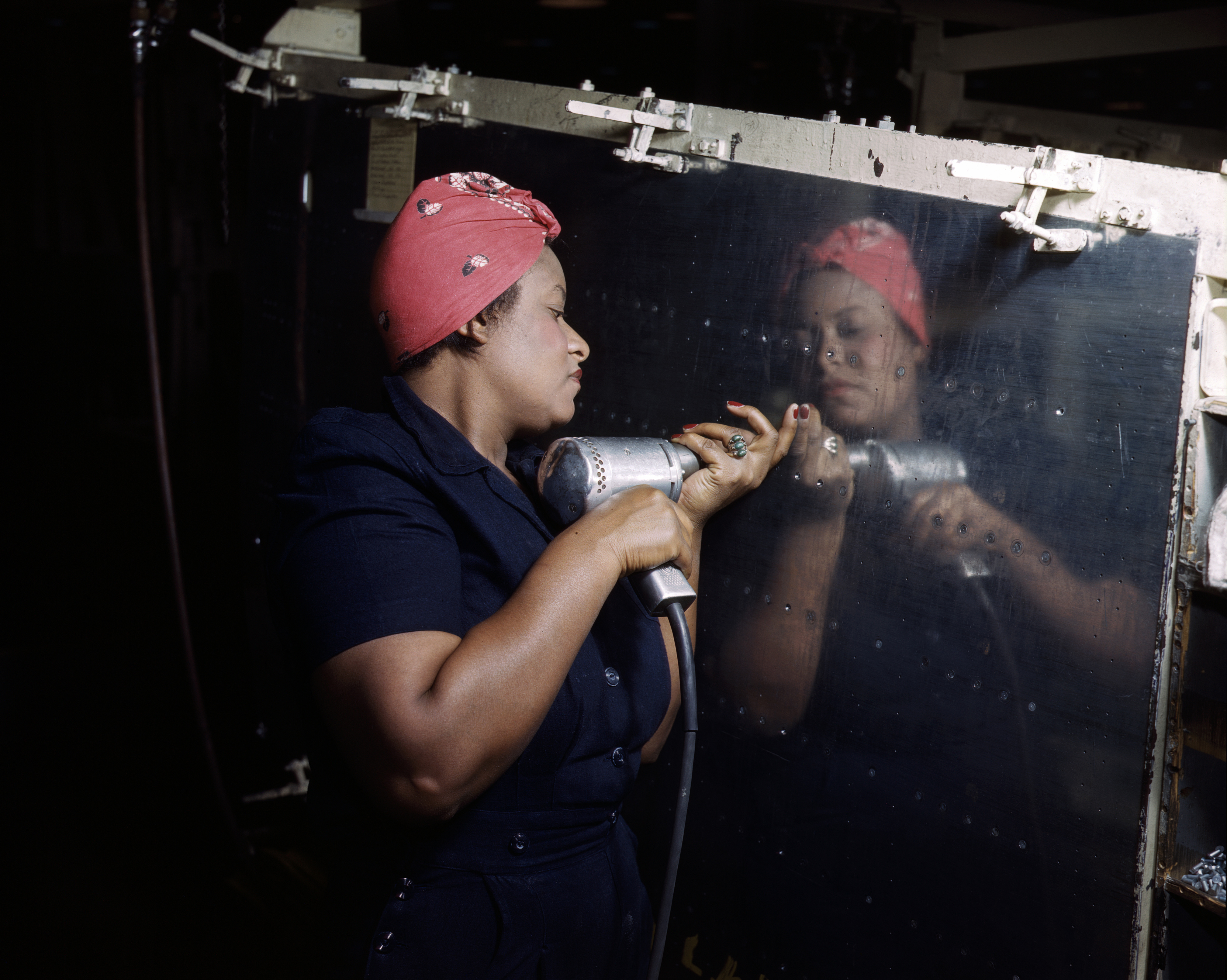
So there are something like five different real-life women who are supposed to have gone into the composite image of Rosie the Riveter, which started to crystallize around the popular song of the same name in 1942 and accelerated through the war, incorporating the two famous paintings and many women's experience of war work along the way. To the best of my knowledge, none of them was this woman photographed at Vultee-Nashville in 1943. (I could not easily find her name on the internet. I'm hoping it was at least recorded at the time, or that she or a relative later recognized and identified the photo.) I also believe all of those women were white. Black women were a major part of the American wartime workforce, however, and from the first moment I saw the photo, that woman has always looked like Rosie the Riveter to me. I hope people told her that.
no subject
(Anonymous) 2017-02-02 09:11 am (UTC)(link)no subject
no subject
No argument. And she is strong, and she knows exactly what she's doing, and she looks beautiful doing it, all of which are aspects of Rosie.