
![[personal profile]](https://www.dreamwidth.org/img/silk/identity/user.png)


My tenses are balled up, but my heart's in the right place
I have been trying to put this post together since January. I hope somebody reads it before the weekend.
So over Christmas when![[livejournal.com profile]](https://www.dreamwidth.org/img/external/lj-userinfo.gif) derspatchel and I were staying at my parents' house, I needed something to read as always and right there on the window seat was Otto Penzler's The Black Lizard Big Book of Black Mask Stories (2010). The title is not exaggerating. The paperback is about the size of a healthy volume of the OED and almost as slangy. I enjoyed the original serialized version of Dashiell Hammett's The Maltese Falcon (1929) and Ramon Decolta's Rainbow Diamonds (1931), but I was really struck by a short story called "Doors in the Dark" (1933) by Frederick Nebel. I'd heard of the series it belonged to. I decided to see how many of the stories were available these days.
derspatchel and I were staying at my parents' house, I needed something to read as always and right there on the window seat was Otto Penzler's The Black Lizard Big Book of Black Mask Stories (2010). The title is not exaggerating. The paperback is about the size of a healthy volume of the OED and almost as slangy. I enjoyed the original serialized version of Dashiell Hammett's The Maltese Falcon (1929) and Ramon Decolta's Rainbow Diamonds (1931), but I was really struck by a short story called "Doors in the Dark" (1933) by Frederick Nebel. I'd heard of the series it belonged to. I decided to see how many of the stories were available these days.
Over the last weekend of the old year and the first weekend of the new one, I read my way through all thirty-seven novelettes about John X. Kennedy of the Free Press and Captain Stephen J. MacBride of Richmond City, originally published in the legendary pulp magazine Black Mask between 1928 and 1936 and recently collected in four sequential volumes: Raw Law: The Complete Cases of MacBride & Kennedy Volume 1, 1928–30 (2013), Shake-Down: The Complete Cases of MacBride & Kennedy Volume 2, 1930–33 (2013), Too Young to Die: The Complete Cases of MacBride & Kennedy Volume 3, 1933–35 (2014), and Winter Kill: The Complete Cases of MacBride & Kennedy Volume 4, 1935–36 (2014). The first volume was an experiment; when the remaining three came in to Porter Square Books, I read them straight through in two nights. Immediately afterward I tried to write about the stories, got a couple of thousand words in, and imploded in a puff of citation. This time around I've tried to cut down on the parentheses. Fictional and dysfunctional as he may be, Kennedy had better appreciate the lengths I go to for him and really interesting pulp.
To be fair, the first volume—roughly the first two years of the series—is only good pulp. The first five stories are sometimes grouped under the title "The Crimes of Richmond City" and that's exactly what you get. You have honest cops and crooked cops and political bosses and bootleggers and raids and murders and punches and graft and guns. Most of the characters are hardboiled types, ethnic stereotypes included. The plots are violent and fast-moving and tend to solve their crimes at the last minute, often by convenience rather than sleuthwork; the prose is chunky and vivid and occasionally difficult to parse. I found the stories compulsively readable, but that didn't stop me from wanting to edit them. There were three recurring elements that I noted as unusual and all of them were characterizations.
First, the setting. We get more detail on Richmond City as the series progresses, but it's a character from the first story on. It's on the East Coast ("New Guns for Old," 1929) and we know it's northerly because it demonstrates the inimitably cruddy winter weather found from New York to Maine. It has a port and a river and suburbs and a theater district. It's not an analogue of Boston or New York City, because both of these cities exist within the world of Nebel's stories and can be easily reached by trains leaving from Richmond City's Union Station ("Backwash," May 1932)—New York in two hours—which really makes me think of the Northeast Corridor, although the only line mentioned by name is the usefully vague "Great Eastern & Central Railway" ("Tough Treatment," January 1930). There is also a train to Montreal. My best-guess mental map locates it somewhere in Connecticut. Without a prominent university, I can't think of Richmond City as New Haven, but I can envision it where we have Bridgeport. It's heavy on industry and, since the advent of Prohibition, crime. If it had magic, it would probably be Felport. We get the names of streets, neighborhoods, wards, trucking companies, telephone exchanges, politicians, entertainers, public libraries, fences, snitches, license plates, shipping lines, all the usual minutiae of urban worldbuilding; seeing it applied outside of a secondary-world context, however, is really fun. As written, the city comes off as slightly too two-fisted to make a good vacation spot, but it's also true that prolonged exposure to film noir leaves the impression that nobody lives in Los Angeles but crooks, dopes, and the occasional bemused carhop. The theater scene is probably a credit to its arts council.1
Secondly, MacBride. He's a classic pulp hero in that he's an incorruptible force of law in a city where even the Mayor is on the take ("Law Without Law," April 1929), but he's also a middle-aged family man with a wife with whom he is very much in love, a college-age daughter about whom he worries with the crime rate the way it is, and a house in the suburbs with a mortgage on it ("Dog Eat Dog," October 1928). Being an honest cop has done his salary no favors ("Graft," May 1929), so he carries heavy insurance to take care of his family when he dies in the line of duty ("The Law Laughs Last," November 1928). He exists in a milieu where shootouts take place as often as arrests and it is considered good policing to bring suspects in with bruises, but he's not a vigilante cop: one of the engines of his character is the tension of anger and restraint, of trying to play by the rules when the rules keep changing hands for cash. Even when it's personal and he regrets his forbearance afterward, he's not a jury or an executioner, he's a captain of police. Sometimes he wishes he'd been a plumber like his father.
Lastly, Kennedy, though he really gets interesting under the cut. At this stage he's a supporting player who's stealing his way into the spotlight; he slopes into scenes with his hands in his pockets and a cigarette in the corner of his mouth, helps himself to drinks from the bottle in MacBride's desk and cigars from the box on top of it, advises and annoys the police in equal measure and turns it all into front-page news. He always looks tired; sometimes he looks exhausted. His knowledge of the city's rigged politics is casually encyclopedic and he has a cynical bon mot for every level of it. In the opening story of the series ("Raw Law," September 1928), he describes himself as "hard-boiled as hell" and he's right—although MacBride is the professionally tougher character, the reporter is the one whom nothing can shock. Like most characters of his type, he gets the best lines in the story, whichever story it is. "In the Spring—tra-la—a young man's fancy and all that crap. Which has nothing to do with the case" ("Hell-Smoke," November 1929).
If slam-bang, trash-talking action were all the MacBride and Kennedy stories had to recommend them, I wouldn't be writing this post. Raw Law was a sufficiently distracting read that I ordered the rest of the series, but I wouldn't call its nine novelettes masterpieces of the genre so much as really solid type species. The more time Nebel spends on these characters and their world, however, the more something happens that is never guaranteed in a long-running series, though it's always a victory for art when it occurs. The stories get better. The style improves until it's almost graceful, even achieving at times a curt, rhythmic poetry. The plotting becomes more complex. The ethnic slurs and stereotypes start to recede.2 Minor characters take on personalities beyond their necessity to the plot. Recurring characters deepen and gain side plots of their own. The city becomes less flagrantly corrupt and therefore more ethically complicated. And it turns out that if you take the archetype of the hardboiled, wisecracking, perpetually tight reporter and drop it into three dimensions, what you get is a real person with a severe drinking problem whose friends really worry about him, because no human being can actually drink as much as a fictional character in this genre and stay healthy and/or employed.
I have difficulty expressing the delight I feel at this development. Kennedy in Raw Law and the early stories of Shake-Down is a nicely done archetype with some appealing quirks, like his flamboyant way with hyperbole, understatement, and knowing misquotation, and some less savory ones, like his initially frequent use of racial language. Kennedy as he comes into his own in Too Young to Die and Winter Kill is unlike any other hardboiled series character I have yet run into. The reality of his alcoholism has a lot to do with it, I think, but so does his general fragility. In a universe sharply divided between hard-fisted men and yellow-bellied rats, Kennedy is flimsy, tenacious, liminal. Between cycling states of drunkenness, hangover, and stone broke sobriety, he's got all the physical presence of a wet noodle. He gets winded chasing a suspect in "Rough Reform" (March 1933), he wins fights almost exclusively through dirty tricks or the borrowed leverage of a gun—he doesn't own or carry one regularly, making him about the only character in the series who goes about unarmed—and he's so easily beaten up that he lampshades the fact more than once when threatened with physical intimidation: "Go ahead, sweetheart, hit me. A child could knock me down" ("Deep Red," August 1936). He's not hard to scare, either. He's hard to scare off, but he readily admits to everything from jittery nerves to genuine terror and as often as not a piece of day-saving crazy bravado like the mirror trick in "Be Your Age" (August 1934) or the decoying of his own kidnappers in "That's Kennedy" (May 1935) is followed by a well-warranted collapse: "I was scared, you dope! I was scared stiff. For tears in your eyes, what do you expect?" He rarely loses his ability to crack wise, but that's no sign of a stiff upper lip; it's established early on that only complete unconsciousness can keep Kennedy from being a smartass. Even so, while he is elaborately contemptuous of greed, hypocrisy, and stupidity, he has a lot of time for weakness or unhappiness: "She lay panting and sobbing a little, but he had had crying jags himself and did not mind" ("Take It and Like It," June 1934). My knowledge of the pulps is not as exhaustive as some other genres, but I don't think crying jags are a character trait of Philip Marlowe or the Continental Op.
Regarding his middle initial, we find out in "Lay Down the Law" (November 1933) that "[i]t doesn't stand for anything. When he joined the army, he said his name was John Kennedy. They asked him for another initial and he said he didn't have any. They said he had to have one, so he said, 'All right, make it X.' They asked him what it stood for and he didn't know, but said offhand one of those gadgets you play with sticks sort of." In addition to explaining a lot about Kennedy's attitude toward authority, this story is one of the only clues we get about his age. In his first appearance in 1928, he's described as having "a young-old face, a vague smile, and the whimsical eyes of the wicked and the wise." In a story published in 1935, we learn that ten years previously he was the mentor of a gossip columnist now in his late twenties. I've always assumed he's about the same age as the century, give or take whatever he put on his enlistment papers. It's an essential part of his characterization that we never find out. By contrast, MacBride is forty on the first page of "Raw Law" and ages normally throughout. But MacBride is a very definite person:
Captain Steve MacBride was a tall square-shouldered man of forty more or less hard-bitten years. He had a long, rough-chiseled face, steady eyes, a beak of a nose, and a wide, firm mouth that years of fighting his own and others' wills had hardened. His face shone ruddily, cleanly, as if it were used to frequent and vigorous contact with soap and water. For eighteen years he had been connected, in one capacity or another, with Richmond City's police department, and Richmond City today is a somewhat hectic community of almost a hundred-thousand population.
The classic description of Kennedy is much less clear-cut:
His pale hair was tangled, his pale eyes looked foggy and marks of dissipation lined his young-old face. There was something ageless about Kennedy—something worn and battered and washed-out; and also, something wise and good-naturedly wicked, like a benign satyr. He took nothing seriously—least of all himself [. . .] A little round-shouldered, a little hollow-chested, he looked as if a good wind might knock him over.
At the time of this portrait ("Bad News," March 1934), he is also wearing carpet slippers borrowed from the barman, because his own shoes are drying on the radiator: Kennedy doesn't own galoshes, never has a coat suitable for the weather, and generally looks like a first-class bum except on unavoidable social occasions when he gets shoved into "a rented evening suit" and invariably spends the evening hiding out in either the bar or the men's room, whichever has fewer people in it ("That's Kennedy"). Neat enough in his first few appearances, by "Alley Rat" (February 1930) he's already walking in from the rain wearing "no overcoat, merely a badly-pressed blue suit, with the coat collar turned up, and a wrinkled blue cap whose peak was out of true" and by "Winter Kill" (November 1935) we're being told that "his clothes were always haphazard and ill-assembled. Color schemes meant nothing in his life. He wore a tie till it was worn out and a hat until someone stole it or until, on one of his benders, he lost it." My corduroy jacket of blessed memory lasted eleven years: I wore it three seasons out of four, more than once restitched both pockets and part of a shoulder seam, and replaced it only when I started losing my keys in the lining, but for long-running shabbiness Kennedy has me beat: "He looked a wreck and here, in the waiting room, he had all the chances of being thrown out for vagrancy" ("Bad News"). He's explicitly mistaken for a tramp in "It's a Gag" (February 1935). He gets the hiccups, falls asleep in the back seats of police cars, takes a lot of insults from honest citizens and criminals alike and rarely refutes any of them. When he pays attention to a case, he's always right. When he gets arrested for obstructing traffic in a pair of boozily borrowed snowshoes, the precinct jail is the safest place MacBride can think to stash him before he gets himself run over ("Winter Kill").
He can get away with it because he's not the only hero of Richmond City. MacBride has enough status and set-jawed stoicism for both of them; Kennedy has the down-and-out poetry, the inside dope. Where the early stories stress the antagonism as well as the mutual respect between the protagonists, the later ones simply take it for granted that MacBride will repeatedly go to bat for the sardonic, erratic, semi-reliable reporter, just as Kennedy will risk his life to ferret out information for MacBride's cases and even clear the captain's name ("Fan Dance," 1936). However carelessly Kennedy throws around raspberries and derisive nicknames like "Skipperino," "old tomato," and "poor old slob" where MacBride can hear him, to third parties he makes his loyalties clear:
"The skipper is a big bull-headed mutt. He's got a one-track mind and he thinks that shield he wears is another kind of bible. It never occurs to him to walk around a tree; he's got to batter his head against it. To him the law, my friend, is the law: good, bad, or indifferent, it's the law. He carries it out as strictly on himself as on any heel that he picks up. Sometimes I think he's goofy. I don't approve of his outlook on life, his foolhardy honesty, his blind loyalty to his shield. But I like him. He's probably the best friend I've got. That being the case [. . .] something's got to be done about conditions in Denmark. They seem to be particularly dirty. Would you have a drink in that desk of yours?"
And his loyalty is paid back in kind:
"That guy Kennedy uncorks the wildest schemes of any guy I ever knew. First off they seem goofy—but when you look back, when you check up, you find out how sane they are. Drunk or sober, on his feet or on his back, that guy always uses his head."
MacBride is speaking of Kennedy's successful deduction of a dope addict at the heart of a blackmail case ("Farewell to Crime," April 1933). Maybe it takes one to know one. Kennedy's self-destructive tendencies hit their nadir during the stories collected in Too Young to Die, when his drinking not only loses him his signature job at the Free Press, it gets him accused of murder ("Take It and Like It") and even risks his relationship with MacBride. When a homeless man is gunned down in Kennedy's coat and hat, the captain turns the town inside out to find his friend before the hoods do, only to discover after the Kennedy-less conclusion of the case that the reporter spent all night on a drunken scavenger hunt, totally unaware he was even in danger of his life. He passes out in a chair, leaving MacBride looking at his friend's "wet shoes, his ghostly face," and feeling "sorry and angry and bitter" ("Lay Down the Law"). Nevertheless, he doesn't give up on Kennedy. He makes him a bed at the station, mixes him hangover cures when he looks worse than usual ("Guns Down," September 1933), winds a heavy woollen scarf around his neck on a bitter winter day ("Crack Down," April 1936), and never does kick him off a case despite official pressure and personal aggravation. When Kennedy finally stabilizes in the very last year of the series, it's clear that it's through pretty heavy intervention on the part of his friends. Where Kennedy mooching MacBride's booze was a regular feature of the early stories, by their next-to-last case MacBride won't give him a drink: "Kennedy, if I didn't think it was bad for you, I'd buy you a bottle of whiskey."–"Let it be bad for me."–"No, Kennedy, I refuse to do you any harm" ("Hard to Take," June 1936). Detectives Moriarity and Cohen, regulars since the third story of the series, pitch in to make sure that Kennedy stays mostly sober and mostly focused and doesn't play in traffic on their watch. Even the minor characters get in on the act. Paderoofski the barman resignedly mixes whatever poison Kennedy orders, but Enrico the restaurant owner makes sure he actually eats something with it. By the final story of the series ("Deep Red"), he's still sufficiently notorious for his knowledge of the city's secret workings and his drinking habits that a crooked politician who recognizes him as a threat knows exactly how to set him up, but this time MacBride moves on to the real mystery without a moment's concern.
Mentioning other characters in the series incidentally points to something else that interests me about the MacBride and Kennedy stories, especially in a hardboiled context: the sense of community. Some of the ensemble scenes around the Second Precinct feel almost like proto-Law & Order (1990–2010) or Brooklyn Nine-Nine (2013–), including—from the start—a not terrible representation of diversity in law enforcement for the time. From "Hell-Smoke," a story I otherwise have little time for:
No, he did not think his men incapable. He knew that Moriarity and Cohen, whatever they appeared to be on the surface, were innately good dicks, ribbed with courage, rough on rats, the one willing to stop a gangster's slug to save the other. And others—plain men, with families and mortgages and flivvers; Germans, Jews, Italians, Irishmen, Polacks, Swedes—all banded together under the sign of the shield and the nightstick . . . There was Detective Ike Cohen, his wounded arm thrust into his pocket—swanky man in the way of dress, reckless in the face of the danger. There he was, racing up Morris Street, with his gun drawn. There was Patrolman Grosskopf, who had a wife and three kids, and who was getting on in years—Grosskopf lumbering up to the call, grim determination on his fat face. And Patrolman Nils Swansen, big and blond, about to be married. And small, dark Patrolman Pagliano, two days a father, and the prize tenor of the Second—bounding along to the call of the shield and the nightstick. And others sweeping into the red face of danger—Eilstein, Maloney, Shanzenbach, Harrigan, Mstibovsky, Honickberg, Malloy, Lindendorf.
Some of these names are throwaway for the sake of worldbuilding; some are recurring characters already and some become so after their first mention here. I genuinely like MacBride's aforementioned two best detectives, the dapper Ike Cohen and the athletic Jake "Mory" Moriarity; despite their ethnically obvious names, neither of them is a caricature. A ladies' man even with his arm in a sling, Cohen has a running gag of losing girlfriends by constantly breaking dates for police business; he experiments with affectations like flipping a quarter à la George Raft and intermittently deals with anti-Semitism ("New Guns for Old"). Moriarity was the "one-time runner-up for the welterweight title" ("The Law Laughs Last") and his married life would be a lot more peaceful if his sister-in-law didn't try to box him every time she comes to visit ("It's a Gag"). They play penny ante, poker dice, and table tennis whether they're on duty or off; eat pastrami sandwiches, risk their lives, argue about chess games they've watched ("Some Die Young," December 1931). They don't have Kennedy's zigzag intuition, but they're not dumb. Police chauffeur Gahagan pretty much is straight-up comic relief, but I enjoy the reveal of the reason that he's such an invaluable part of the Second Precinct—when MacBride goes on vacation with his wife, the reader realizes that when left to his own devices, the captain's an insurance nightmare on wheels: "In Richmond, Virginia, he had driven through a red light, crashed into a truck and lost his right fender, and in Philadelphia he had been arrested for driving the wrong way on a one-way street. But all in all they had had a nice time" ("Take It and Like It"). In a genre I associate with tough, solitary men and the brief connections they make on their way to further disillusion, an evolving backdrop of ensemble comedy-drama is not what I expected to run into. It confuses me a little that there exists no fandom for these stories. Maybe it's just not on AO3.
I am actively surprised that Nebel never wrote a novel about MacBride and Kennedy. It feels like a natural progression; the last couple years of the series tend increasingly toward the literary, as opposed to pulp, as the crime action becomes less important than the relationships of the characters and the milieu through which they move. The characters are still growing. Richmond City has moved out of Prohibition and into the Depression. I would have loved to be able to track MacBride and Kennedy in real time through the decades, much as Margery Allingham did with Albert Campion—Nebel kept writing until his death in 1967. He even wrote novels. I am curious about all three of them. Just none of them, as far as I can tell, were linked to any of his series characters.3
I am somehow not entirely surprised that when the MacBride and Kennedy stories finally hit the screen courtesy of Warner Bros. in 1937, the Kennedy role went to a woman: the eponymous Smart Blonde Torchy Blane, played in seven out of nine films by Glenda Farrell, who had made a hit earlier in the decade as the plucky but more importantly fast-talking and not infrequently hungover girl reporter of Mystery of the Wax Museum (1933); Steve MacBride became her fiancé, played most of the time by Barton MacLane with a slightly re-spelled last name and dialed-back competence to allow for more pointed agency on Torchy's part. Please conclude from these facts whatever you would like about the slash potential of the series. Someday TCM will show one or more of these movies and I will probably enjoy them and experience slight cognitive dissonance.4 God knows how the Production Code will handle the drinking.
The subject header of this post is something that Kennedy says in "Die-Hard" (August 1935) after automatically reporting the address of a murder victim as if the man were still in residence. Who says self-annotating dialogue started with Joss Whedon? Clever, self-deprecating, facetious, true, it's such characteristic Kennedy, I might as well leave it as an exit line. I can't recommend everything about this series, but I can recommend its eventual defining character, the genius loci of Richmond City. I like to think he'd take it philosophically.
1. The theater scene of Richmond City in fact provides one of the funniest lines in the entire series, or at least funniest if you live in the city I do. In "New Guns for Old," Richmond City acquires an honest mayor who proceeds to cause just as much trouble as his corrupt predecessor by cracking down on liquor and vice with such suddenness and severity that it does nothing to disrupt crime in the city except in the sense that displacing it from its usual haunts causes a tidal wave elsewhere. "Then he closed a popular burlesque house and banned presentation of three plays which he considered slightly off-color. The Post-Express screamed at this, because two of the plays had had successful runs in Boston."
2. Nebel never gets over his use of eye dialect to represent accents, which I find very difficult, but I'll take it in return for the decrease in the number of times per page I have to read a whole bunch of period-accurate ethnic/racial epithets. It never quite goes to zero—and I never got used to the narrative use of "white" to mean regular, stand-up, honorable, any more than I accept "Christian" as a natural synonym for decency, generosity, being a mensch—but by the end of Shake-Down it's no longer face-smacking. Nebel's politics also get what I would consider better as the series goes on. In the early entry "Hell-Smoke," the police have to break a labor strike and I get the story's point that the strike leader is a self-serving demagogue who'll sell his men out to the bosses in exchange for "a nice slice of graft" after raising the hopes of desperate workers with legitimate complaints, but I still listen to the way Nebel's police talk about unions and I watch them break up protests and violently protect strike-breakers and you know that gif of the coconut octopus noping its way offscreen? That's me, reading "Hell-Smoke." There is such a thing as being on the wrong side of history and it happened to that story. It's a shame; self-serving demagogues have become topical again.
3. The reprints' introduction by Evan Lewis is invaluable for biographical information and I have relied it on it for most of my knowledge of Frederick Nebel and his other work; I disagree with it frequently on issues of interpretation. Far from being "the most comedic of the entire saga," for example, the Kennedy-starring "Bad News" is a miniature family tragedy with a quietly existential ending. There's a surface misdirection of humor as Kennedy engages to track down an old friend's hot-headed son despite slushy weather, importunate cabbies, and a steadily rising level of blood alcohol, but the prevailing tone is bleak and cavernous, unglamorous as a railway station's waiting room on a chilly, sleety night. Kennedy snarks his way through the plot with his usual motormouth, but he can't talk it into a happy ending. You can't even call the girl at fault a femme fatale; she's just a self-centered, spiteful, attractive kid who makes bank on her looks and almost certainly won't come to a bad end. The sole bright spot is a middle-aged romance which Kennedy furthers to his own loss. "Joe Marino may get married soon . . . There's a dame might have straightened me out." He ends the story so drunk, the barman has to put him to bed. I am very fond of "Bad News." I think it's one of the best stories in the entire nine-year series. It would have made a fantastic little movie in the '30's or '40's, exactly the kind of bittersweet B-list oddity I love running across. A comedy, however, unless you mean it in the strictly Elizabethan sense of ending with a marriage, it is not.
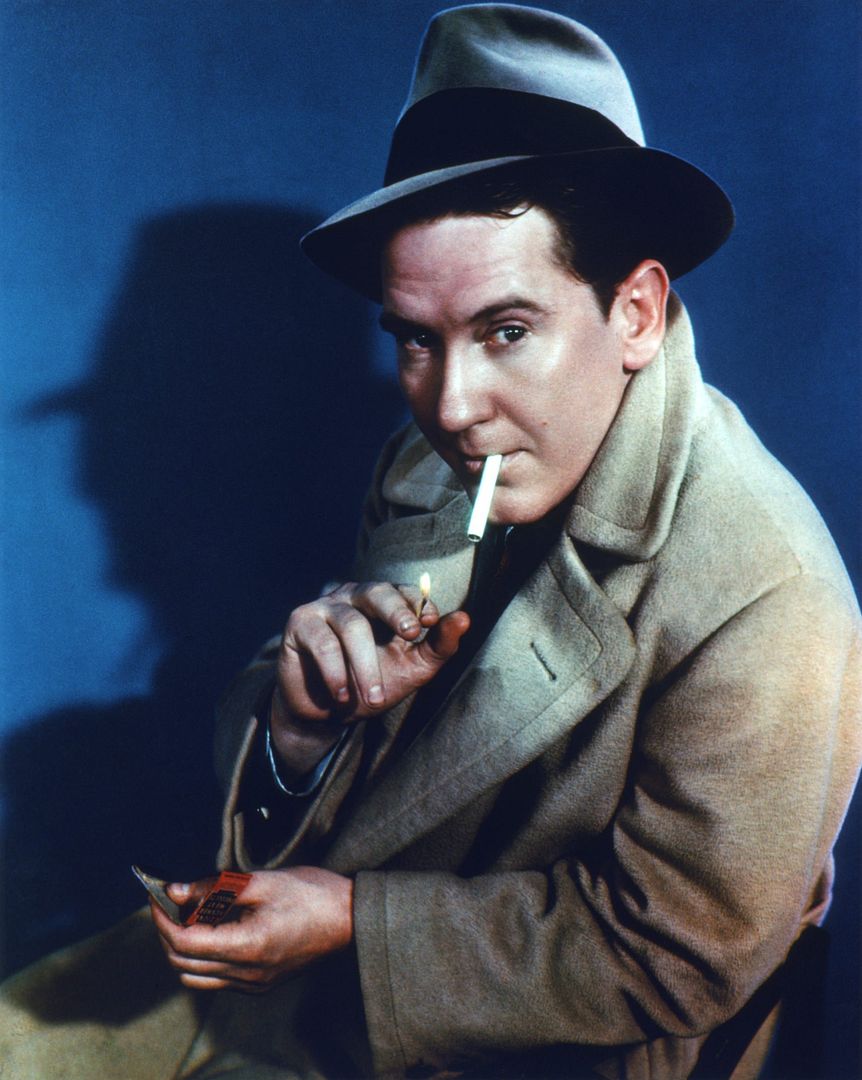
4. It is irresistible to speculate about the casting without the genderswap. I wondered at the time about Roscoe Karns—cynical newspapermen were one of his specialties, boozing optional and fast talk guaranteed. There's a rather nice portrait of Burgess Meredith from Street of Chance (1942) that has the right whimsical smile, albeit Meredith looks a lot more alert than Kennedy is usually described. The character's small size and ironical attitude would have suited Richard Barthelmess, although the actor wouldn't develop the right shadows under his eyes until the late '30's. I'm not sure what a hardboiled Leslie Howard would have looked like—and as much as I love him, he was never plausibly American—but he'd certainly have had the fey self-destructive angle covered. I'm happy to hear suggestions in comments. I'd love to see him drawn by the artist of Tanglefoot.
So over Christmas when
derspatchel and I were staying at my parents' house, I needed something to read as always and right there on the window seat was Otto Penzler's The Black Lizard Big Book of Black Mask Stories (2010). The title is not exaggerating. The paperback is about the size of a healthy volume of the OED and almost as slangy. I enjoyed the original serialized version of Dashiell Hammett's The Maltese Falcon (1929) and Ramon Decolta's Rainbow Diamonds (1931), but I was really struck by a short story called "Doors in the Dark" (1933) by Frederick Nebel. I'd heard of the series it belonged to. I decided to see how many of the stories were available these days.Over the last weekend of the old year and the first weekend of the new one, I read my way through all thirty-seven novelettes about John X. Kennedy of the Free Press and Captain Stephen J. MacBride of Richmond City, originally published in the legendary pulp magazine Black Mask between 1928 and 1936 and recently collected in four sequential volumes: Raw Law: The Complete Cases of MacBride & Kennedy Volume 1, 1928–30 (2013), Shake-Down: The Complete Cases of MacBride & Kennedy Volume 2, 1930–33 (2013), Too Young to Die: The Complete Cases of MacBride & Kennedy Volume 3, 1933–35 (2014), and Winter Kill: The Complete Cases of MacBride & Kennedy Volume 4, 1935–36 (2014). The first volume was an experiment; when the remaining three came in to Porter Square Books, I read them straight through in two nights. Immediately afterward I tried to write about the stories, got a couple of thousand words in, and imploded in a puff of citation. This time around I've tried to cut down on the parentheses. Fictional and dysfunctional as he may be, Kennedy had better appreciate the lengths I go to for him and really interesting pulp.
To be fair, the first volume—roughly the first two years of the series—is only good pulp. The first five stories are sometimes grouped under the title "The Crimes of Richmond City" and that's exactly what you get. You have honest cops and crooked cops and political bosses and bootleggers and raids and murders and punches and graft and guns. Most of the characters are hardboiled types, ethnic stereotypes included. The plots are violent and fast-moving and tend to solve their crimes at the last minute, often by convenience rather than sleuthwork; the prose is chunky and vivid and occasionally difficult to parse. I found the stories compulsively readable, but that didn't stop me from wanting to edit them. There were three recurring elements that I noted as unusual and all of them were characterizations.
First, the setting. We get more detail on Richmond City as the series progresses, but it's a character from the first story on. It's on the East Coast ("New Guns for Old," 1929) and we know it's northerly because it demonstrates the inimitably cruddy winter weather found from New York to Maine. It has a port and a river and suburbs and a theater district. It's not an analogue of Boston or New York City, because both of these cities exist within the world of Nebel's stories and can be easily reached by trains leaving from Richmond City's Union Station ("Backwash," May 1932)—New York in two hours—which really makes me think of the Northeast Corridor, although the only line mentioned by name is the usefully vague "Great Eastern & Central Railway" ("Tough Treatment," January 1930). There is also a train to Montreal. My best-guess mental map locates it somewhere in Connecticut. Without a prominent university, I can't think of Richmond City as New Haven, but I can envision it where we have Bridgeport. It's heavy on industry and, since the advent of Prohibition, crime. If it had magic, it would probably be Felport. We get the names of streets, neighborhoods, wards, trucking companies, telephone exchanges, politicians, entertainers, public libraries, fences, snitches, license plates, shipping lines, all the usual minutiae of urban worldbuilding; seeing it applied outside of a secondary-world context, however, is really fun. As written, the city comes off as slightly too two-fisted to make a good vacation spot, but it's also true that prolonged exposure to film noir leaves the impression that nobody lives in Los Angeles but crooks, dopes, and the occasional bemused carhop. The theater scene is probably a credit to its arts council.1
Secondly, MacBride. He's a classic pulp hero in that he's an incorruptible force of law in a city where even the Mayor is on the take ("Law Without Law," April 1929), but he's also a middle-aged family man with a wife with whom he is very much in love, a college-age daughter about whom he worries with the crime rate the way it is, and a house in the suburbs with a mortgage on it ("Dog Eat Dog," October 1928). Being an honest cop has done his salary no favors ("Graft," May 1929), so he carries heavy insurance to take care of his family when he dies in the line of duty ("The Law Laughs Last," November 1928). He exists in a milieu where shootouts take place as often as arrests and it is considered good policing to bring suspects in with bruises, but he's not a vigilante cop: one of the engines of his character is the tension of anger and restraint, of trying to play by the rules when the rules keep changing hands for cash. Even when it's personal and he regrets his forbearance afterward, he's not a jury or an executioner, he's a captain of police. Sometimes he wishes he'd been a plumber like his father.
Lastly, Kennedy, though he really gets interesting under the cut. At this stage he's a supporting player who's stealing his way into the spotlight; he slopes into scenes with his hands in his pockets and a cigarette in the corner of his mouth, helps himself to drinks from the bottle in MacBride's desk and cigars from the box on top of it, advises and annoys the police in equal measure and turns it all into front-page news. He always looks tired; sometimes he looks exhausted. His knowledge of the city's rigged politics is casually encyclopedic and he has a cynical bon mot for every level of it. In the opening story of the series ("Raw Law," September 1928), he describes himself as "hard-boiled as hell" and he's right—although MacBride is the professionally tougher character, the reporter is the one whom nothing can shock. Like most characters of his type, he gets the best lines in the story, whichever story it is. "In the Spring—tra-la—a young man's fancy and all that crap. Which has nothing to do with the case" ("Hell-Smoke," November 1929).
If slam-bang, trash-talking action were all the MacBride and Kennedy stories had to recommend them, I wouldn't be writing this post. Raw Law was a sufficiently distracting read that I ordered the rest of the series, but I wouldn't call its nine novelettes masterpieces of the genre so much as really solid type species. The more time Nebel spends on these characters and their world, however, the more something happens that is never guaranteed in a long-running series, though it's always a victory for art when it occurs. The stories get better. The style improves until it's almost graceful, even achieving at times a curt, rhythmic poetry. The plotting becomes more complex. The ethnic slurs and stereotypes start to recede.2 Minor characters take on personalities beyond their necessity to the plot. Recurring characters deepen and gain side plots of their own. The city becomes less flagrantly corrupt and therefore more ethically complicated. And it turns out that if you take the archetype of the hardboiled, wisecracking, perpetually tight reporter and drop it into three dimensions, what you get is a real person with a severe drinking problem whose friends really worry about him, because no human being can actually drink as much as a fictional character in this genre and stay healthy and/or employed.
I have difficulty expressing the delight I feel at this development. Kennedy in Raw Law and the early stories of Shake-Down is a nicely done archetype with some appealing quirks, like his flamboyant way with hyperbole, understatement, and knowing misquotation, and some less savory ones, like his initially frequent use of racial language. Kennedy as he comes into his own in Too Young to Die and Winter Kill is unlike any other hardboiled series character I have yet run into. The reality of his alcoholism has a lot to do with it, I think, but so does his general fragility. In a universe sharply divided between hard-fisted men and yellow-bellied rats, Kennedy is flimsy, tenacious, liminal. Between cycling states of drunkenness, hangover, and stone broke sobriety, he's got all the physical presence of a wet noodle. He gets winded chasing a suspect in "Rough Reform" (March 1933), he wins fights almost exclusively through dirty tricks or the borrowed leverage of a gun—he doesn't own or carry one regularly, making him about the only character in the series who goes about unarmed—and he's so easily beaten up that he lampshades the fact more than once when threatened with physical intimidation: "Go ahead, sweetheart, hit me. A child could knock me down" ("Deep Red," August 1936). He's not hard to scare, either. He's hard to scare off, but he readily admits to everything from jittery nerves to genuine terror and as often as not a piece of day-saving crazy bravado like the mirror trick in "Be Your Age" (August 1934) or the decoying of his own kidnappers in "That's Kennedy" (May 1935) is followed by a well-warranted collapse: "I was scared, you dope! I was scared stiff. For tears in your eyes, what do you expect?" He rarely loses his ability to crack wise, but that's no sign of a stiff upper lip; it's established early on that only complete unconsciousness can keep Kennedy from being a smartass. Even so, while he is elaborately contemptuous of greed, hypocrisy, and stupidity, he has a lot of time for weakness or unhappiness: "She lay panting and sobbing a little, but he had had crying jags himself and did not mind" ("Take It and Like It," June 1934). My knowledge of the pulps is not as exhaustive as some other genres, but I don't think crying jags are a character trait of Philip Marlowe or the Continental Op.
Regarding his middle initial, we find out in "Lay Down the Law" (November 1933) that "[i]t doesn't stand for anything. When he joined the army, he said his name was John Kennedy. They asked him for another initial and he said he didn't have any. They said he had to have one, so he said, 'All right, make it X.' They asked him what it stood for and he didn't know, but said offhand one of those gadgets you play with sticks sort of." In addition to explaining a lot about Kennedy's attitude toward authority, this story is one of the only clues we get about his age. In his first appearance in 1928, he's described as having "a young-old face, a vague smile, and the whimsical eyes of the wicked and the wise." In a story published in 1935, we learn that ten years previously he was the mentor of a gossip columnist now in his late twenties. I've always assumed he's about the same age as the century, give or take whatever he put on his enlistment papers. It's an essential part of his characterization that we never find out. By contrast, MacBride is forty on the first page of "Raw Law" and ages normally throughout. But MacBride is a very definite person:
Captain Steve MacBride was a tall square-shouldered man of forty more or less hard-bitten years. He had a long, rough-chiseled face, steady eyes, a beak of a nose, and a wide, firm mouth that years of fighting his own and others' wills had hardened. His face shone ruddily, cleanly, as if it were used to frequent and vigorous contact with soap and water. For eighteen years he had been connected, in one capacity or another, with Richmond City's police department, and Richmond City today is a somewhat hectic community of almost a hundred-thousand population.
The classic description of Kennedy is much less clear-cut:
His pale hair was tangled, his pale eyes looked foggy and marks of dissipation lined his young-old face. There was something ageless about Kennedy—something worn and battered and washed-out; and also, something wise and good-naturedly wicked, like a benign satyr. He took nothing seriously—least of all himself [. . .] A little round-shouldered, a little hollow-chested, he looked as if a good wind might knock him over.
At the time of this portrait ("Bad News," March 1934), he is also wearing carpet slippers borrowed from the barman, because his own shoes are drying on the radiator: Kennedy doesn't own galoshes, never has a coat suitable for the weather, and generally looks like a first-class bum except on unavoidable social occasions when he gets shoved into "a rented evening suit" and invariably spends the evening hiding out in either the bar or the men's room, whichever has fewer people in it ("That's Kennedy"). Neat enough in his first few appearances, by "Alley Rat" (February 1930) he's already walking in from the rain wearing "no overcoat, merely a badly-pressed blue suit, with the coat collar turned up, and a wrinkled blue cap whose peak was out of true" and by "Winter Kill" (November 1935) we're being told that "his clothes were always haphazard and ill-assembled. Color schemes meant nothing in his life. He wore a tie till it was worn out and a hat until someone stole it or until, on one of his benders, he lost it." My corduroy jacket of blessed memory lasted eleven years: I wore it three seasons out of four, more than once restitched both pockets and part of a shoulder seam, and replaced it only when I started losing my keys in the lining, but for long-running shabbiness Kennedy has me beat: "He looked a wreck and here, in the waiting room, he had all the chances of being thrown out for vagrancy" ("Bad News"). He's explicitly mistaken for a tramp in "It's a Gag" (February 1935). He gets the hiccups, falls asleep in the back seats of police cars, takes a lot of insults from honest citizens and criminals alike and rarely refutes any of them. When he pays attention to a case, he's always right. When he gets arrested for obstructing traffic in a pair of boozily borrowed snowshoes, the precinct jail is the safest place MacBride can think to stash him before he gets himself run over ("Winter Kill").
He can get away with it because he's not the only hero of Richmond City. MacBride has enough status and set-jawed stoicism for both of them; Kennedy has the down-and-out poetry, the inside dope. Where the early stories stress the antagonism as well as the mutual respect between the protagonists, the later ones simply take it for granted that MacBride will repeatedly go to bat for the sardonic, erratic, semi-reliable reporter, just as Kennedy will risk his life to ferret out information for MacBride's cases and even clear the captain's name ("Fan Dance," 1936). However carelessly Kennedy throws around raspberries and derisive nicknames like "Skipperino," "old tomato," and "poor old slob" where MacBride can hear him, to third parties he makes his loyalties clear:
"The skipper is a big bull-headed mutt. He's got a one-track mind and he thinks that shield he wears is another kind of bible. It never occurs to him to walk around a tree; he's got to batter his head against it. To him the law, my friend, is the law: good, bad, or indifferent, it's the law. He carries it out as strictly on himself as on any heel that he picks up. Sometimes I think he's goofy. I don't approve of his outlook on life, his foolhardy honesty, his blind loyalty to his shield. But I like him. He's probably the best friend I've got. That being the case [. . .] something's got to be done about conditions in Denmark. They seem to be particularly dirty. Would you have a drink in that desk of yours?"
And his loyalty is paid back in kind:
"That guy Kennedy uncorks the wildest schemes of any guy I ever knew. First off they seem goofy—but when you look back, when you check up, you find out how sane they are. Drunk or sober, on his feet or on his back, that guy always uses his head."
MacBride is speaking of Kennedy's successful deduction of a dope addict at the heart of a blackmail case ("Farewell to Crime," April 1933). Maybe it takes one to know one. Kennedy's self-destructive tendencies hit their nadir during the stories collected in Too Young to Die, when his drinking not only loses him his signature job at the Free Press, it gets him accused of murder ("Take It and Like It") and even risks his relationship with MacBride. When a homeless man is gunned down in Kennedy's coat and hat, the captain turns the town inside out to find his friend before the hoods do, only to discover after the Kennedy-less conclusion of the case that the reporter spent all night on a drunken scavenger hunt, totally unaware he was even in danger of his life. He passes out in a chair, leaving MacBride looking at his friend's "wet shoes, his ghostly face," and feeling "sorry and angry and bitter" ("Lay Down the Law"). Nevertheless, he doesn't give up on Kennedy. He makes him a bed at the station, mixes him hangover cures when he looks worse than usual ("Guns Down," September 1933), winds a heavy woollen scarf around his neck on a bitter winter day ("Crack Down," April 1936), and never does kick him off a case despite official pressure and personal aggravation. When Kennedy finally stabilizes in the very last year of the series, it's clear that it's through pretty heavy intervention on the part of his friends. Where Kennedy mooching MacBride's booze was a regular feature of the early stories, by their next-to-last case MacBride won't give him a drink: "Kennedy, if I didn't think it was bad for you, I'd buy you a bottle of whiskey."–"Let it be bad for me."–"No, Kennedy, I refuse to do you any harm" ("Hard to Take," June 1936). Detectives Moriarity and Cohen, regulars since the third story of the series, pitch in to make sure that Kennedy stays mostly sober and mostly focused and doesn't play in traffic on their watch. Even the minor characters get in on the act. Paderoofski the barman resignedly mixes whatever poison Kennedy orders, but Enrico the restaurant owner makes sure he actually eats something with it. By the final story of the series ("Deep Red"), he's still sufficiently notorious for his knowledge of the city's secret workings and his drinking habits that a crooked politician who recognizes him as a threat knows exactly how to set him up, but this time MacBride moves on to the real mystery without a moment's concern.
Mentioning other characters in the series incidentally points to something else that interests me about the MacBride and Kennedy stories, especially in a hardboiled context: the sense of community. Some of the ensemble scenes around the Second Precinct feel almost like proto-Law & Order (1990–2010) or Brooklyn Nine-Nine (2013–), including—from the start—a not terrible representation of diversity in law enforcement for the time. From "Hell-Smoke," a story I otherwise have little time for:
No, he did not think his men incapable. He knew that Moriarity and Cohen, whatever they appeared to be on the surface, were innately good dicks, ribbed with courage, rough on rats, the one willing to stop a gangster's slug to save the other. And others—plain men, with families and mortgages and flivvers; Germans, Jews, Italians, Irishmen, Polacks, Swedes—all banded together under the sign of the shield and the nightstick . . . There was Detective Ike Cohen, his wounded arm thrust into his pocket—swanky man in the way of dress, reckless in the face of the danger. There he was, racing up Morris Street, with his gun drawn. There was Patrolman Grosskopf, who had a wife and three kids, and who was getting on in years—Grosskopf lumbering up to the call, grim determination on his fat face. And Patrolman Nils Swansen, big and blond, about to be married. And small, dark Patrolman Pagliano, two days a father, and the prize tenor of the Second—bounding along to the call of the shield and the nightstick. And others sweeping into the red face of danger—Eilstein, Maloney, Shanzenbach, Harrigan, Mstibovsky, Honickberg, Malloy, Lindendorf.
Some of these names are throwaway for the sake of worldbuilding; some are recurring characters already and some become so after their first mention here. I genuinely like MacBride's aforementioned two best detectives, the dapper Ike Cohen and the athletic Jake "Mory" Moriarity; despite their ethnically obvious names, neither of them is a caricature. A ladies' man even with his arm in a sling, Cohen has a running gag of losing girlfriends by constantly breaking dates for police business; he experiments with affectations like flipping a quarter à la George Raft and intermittently deals with anti-Semitism ("New Guns for Old"). Moriarity was the "one-time runner-up for the welterweight title" ("The Law Laughs Last") and his married life would be a lot more peaceful if his sister-in-law didn't try to box him every time she comes to visit ("It's a Gag"). They play penny ante, poker dice, and table tennis whether they're on duty or off; eat pastrami sandwiches, risk their lives, argue about chess games they've watched ("Some Die Young," December 1931). They don't have Kennedy's zigzag intuition, but they're not dumb. Police chauffeur Gahagan pretty much is straight-up comic relief, but I enjoy the reveal of the reason that he's such an invaluable part of the Second Precinct—when MacBride goes on vacation with his wife, the reader realizes that when left to his own devices, the captain's an insurance nightmare on wheels: "In Richmond, Virginia, he had driven through a red light, crashed into a truck and lost his right fender, and in Philadelphia he had been arrested for driving the wrong way on a one-way street. But all in all they had had a nice time" ("Take It and Like It"). In a genre I associate with tough, solitary men and the brief connections they make on their way to further disillusion, an evolving backdrop of ensemble comedy-drama is not what I expected to run into. It confuses me a little that there exists no fandom for these stories. Maybe it's just not on AO3.
I am actively surprised that Nebel never wrote a novel about MacBride and Kennedy. It feels like a natural progression; the last couple years of the series tend increasingly toward the literary, as opposed to pulp, as the crime action becomes less important than the relationships of the characters and the milieu through which they move. The characters are still growing. Richmond City has moved out of Prohibition and into the Depression. I would have loved to be able to track MacBride and Kennedy in real time through the decades, much as Margery Allingham did with Albert Campion—Nebel kept writing until his death in 1967. He even wrote novels. I am curious about all three of them. Just none of them, as far as I can tell, were linked to any of his series characters.3
I am somehow not entirely surprised that when the MacBride and Kennedy stories finally hit the screen courtesy of Warner Bros. in 1937, the Kennedy role went to a woman: the eponymous Smart Blonde Torchy Blane, played in seven out of nine films by Glenda Farrell, who had made a hit earlier in the decade as the plucky but more importantly fast-talking and not infrequently hungover girl reporter of Mystery of the Wax Museum (1933); Steve MacBride became her fiancé, played most of the time by Barton MacLane with a slightly re-spelled last name and dialed-back competence to allow for more pointed agency on Torchy's part. Please conclude from these facts whatever you would like about the slash potential of the series. Someday TCM will show one or more of these movies and I will probably enjoy them and experience slight cognitive dissonance.4 God knows how the Production Code will handle the drinking.
The subject header of this post is something that Kennedy says in "Die-Hard" (August 1935) after automatically reporting the address of a murder victim as if the man were still in residence. Who says self-annotating dialogue started with Joss Whedon? Clever, self-deprecating, facetious, true, it's such characteristic Kennedy, I might as well leave it as an exit line. I can't recommend everything about this series, but I can recommend its eventual defining character, the genius loci of Richmond City. I like to think he'd take it philosophically.
1. The theater scene of Richmond City in fact provides one of the funniest lines in the entire series, or at least funniest if you live in the city I do. In "New Guns for Old," Richmond City acquires an honest mayor who proceeds to cause just as much trouble as his corrupt predecessor by cracking down on liquor and vice with such suddenness and severity that it does nothing to disrupt crime in the city except in the sense that displacing it from its usual haunts causes a tidal wave elsewhere. "Then he closed a popular burlesque house and banned presentation of three plays which he considered slightly off-color. The Post-Express screamed at this, because two of the plays had had successful runs in Boston."
2. Nebel never gets over his use of eye dialect to represent accents, which I find very difficult, but I'll take it in return for the decrease in the number of times per page I have to read a whole bunch of period-accurate ethnic/racial epithets. It never quite goes to zero—and I never got used to the narrative use of "white" to mean regular, stand-up, honorable, any more than I accept "Christian" as a natural synonym for decency, generosity, being a mensch—but by the end of Shake-Down it's no longer face-smacking. Nebel's politics also get what I would consider better as the series goes on. In the early entry "Hell-Smoke," the police have to break a labor strike and I get the story's point that the strike leader is a self-serving demagogue who'll sell his men out to the bosses in exchange for "a nice slice of graft" after raising the hopes of desperate workers with legitimate complaints, but I still listen to the way Nebel's police talk about unions and I watch them break up protests and violently protect strike-breakers and you know that gif of the coconut octopus noping its way offscreen? That's me, reading "Hell-Smoke." There is such a thing as being on the wrong side of history and it happened to that story. It's a shame; self-serving demagogues have become topical again.
3. The reprints' introduction by Evan Lewis is invaluable for biographical information and I have relied it on it for most of my knowledge of Frederick Nebel and his other work; I disagree with it frequently on issues of interpretation. Far from being "the most comedic of the entire saga," for example, the Kennedy-starring "Bad News" is a miniature family tragedy with a quietly existential ending. There's a surface misdirection of humor as Kennedy engages to track down an old friend's hot-headed son despite slushy weather, importunate cabbies, and a steadily rising level of blood alcohol, but the prevailing tone is bleak and cavernous, unglamorous as a railway station's waiting room on a chilly, sleety night. Kennedy snarks his way through the plot with his usual motormouth, but he can't talk it into a happy ending. You can't even call the girl at fault a femme fatale; she's just a self-centered, spiteful, attractive kid who makes bank on her looks and almost certainly won't come to a bad end. The sole bright spot is a middle-aged romance which Kennedy furthers to his own loss. "Joe Marino may get married soon . . . There's a dame might have straightened me out." He ends the story so drunk, the barman has to put him to bed. I am very fond of "Bad News." I think it's one of the best stories in the entire nine-year series. It would have made a fantastic little movie in the '30's or '40's, exactly the kind of bittersweet B-list oddity I love running across. A comedy, however, unless you mean it in the strictly Elizabethan sense of ending with a marriage, it is not.
4. It is irresistible to speculate about the casting without the genderswap. I wondered at the time about Roscoe Karns—cynical newspapermen were one of his specialties, boozing optional and fast talk guaranteed. There's a rather nice portrait of Burgess Meredith from Street of Chance (1942) that has the right whimsical smile, albeit Meredith looks a lot more alert than Kennedy is usually described. The character's small size and ironical attitude would have suited Richard Barthelmess, although the actor wouldn't develop the right shadows under his eyes until the late '30's. I'm not sure what a hardboiled Leslie Howard would have looked like—and as much as I love him, he was never plausibly American—but he'd certainly have had the fey self-destructive angle covered. I'm happy to hear suggestions in comments. I'd love to see him drawn by the artist of Tanglefoot.
no subject
I kept being inescapably reminded of Sam Vimes and the ever-growing ensemble of the Watch. Presumably that's less any direct inspiration and more just the fact that they're both working with the same starting archetype, but I do suspect the characters would have some things to say to each other. And that the ensemble break room jawing over overstewed precinct beverages would be even more interesting.
no subject
It was a wonderful surprise! I don't think I can can claim that the stories are great literature of the American twentieth century, but there really is something here. I really wish Nebel had written a MacBride and Kennedy novel.
I kept being inescapably reminded of Sam Vimes and the ever-growing ensemble of the Watch.
Huh. I didn't even make the Discworld connection, but I can see why you thought of it. I should re-read the early Watch novels that I now have a better understanding of the genre they're both spoofing and belong to.
And that the ensemble break room jawing over overstewed precinct beverages would be even more interesting.
Coffee definitely plays a part in the daily life of the Second Precinct, as does a lot of takeout and fast food. (Chinese restaurants must not be in a thing in Richmond City and I'm guessing pizza hadn't yet gone cross-cultural, because neither of these basic staples makes an appearance that I can remember, but whoever sells hamburgers near the station house is making a killing.) I'm pretty sure officers on duty aren't supposed to drink beer anymore, though.