
![[personal profile]](https://www.dreamwidth.org/img/silk/identity/user.png)


I thought I was the stranger around here
Yesterday was pretty much nothing but proofreading in order to make up for the previous day being pretty much nothing but being behind on work. Today it is snowing again. It is one of my fervent hopes that the infrastructure disaster that is currently the MBTA (closing again over the weekend, I have just learned) will put paid to any notions of Boston being ready for the Olympics.
1. Courtesy of![[livejournal.com profile]](https://www.dreamwidth.org/img/external/lj-userinfo.gif) derspatchel: the Doves were not all drowned. After a painstaking restoration of the hundred-year-old typeface as a digital font, the designer has recovered a hundred and fifty pieces of the original, spitefully discarded lead type from the Thames. I find that this makes me extraordinarily happy.
derspatchel: the Doves were not all drowned. After a painstaking restoration of the hundred-year-old typeface as a digital font, the designer has recovered a hundred and fifty pieces of the original, spitefully discarded lead type from the Thames. I find that this makes me extraordinarily happy.
2. Courtesy ofsairaali: Alan Turing's codebreaking notes found weatherstripping a Bletchley hut. And when I say "notes," I mean "top-secret ephemera." Banbury sheets. Workings-out. Scrap papers that should have been destroyed as soon as their writers were done with them, but the huts were jerry-built and drafty and someone needs to stuff something in the cracks before we all come down with pneumonia. How much do I love that some of the notes are indecipherable? "Nobody seems to be able to work out what they are—we've sent things off to GCHQ—and there are a number of items that we've yet to understand properly. We're unveiling a mystery."
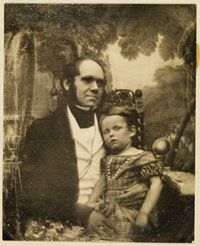
3. Apparently it is Darwin Day. So here is my favorite picture of Charles Darwin: a daguerreotype taken in 1842 with his oldest child William. I saw it for the first time in 2006, when all the images I'd ever seen of Darwin were white-bearded and patriarchal, the elder statesman of evolution. I looked at this one and thought of no one so much as Bob Cratchit, with one of the innumerable little Cratchits on his lap. (Larger, black-and-white here.)
4. Mystery Street (1950) is a delightful, solid little film noir with the distinction of being the first Hollywood production filmed in Boston. If you enjoy time capsules, it is a godsend of location shooting, from a perfectly recognizable Harvard Yard and Beacon Hill to the bars of Scollay Square and a showdown in the railyards of Trinity Station. Boston accents are negligible to hilarious, but the degree and technical detail of forensic science onscreen is unmatched by anything I've seen from its decade. There is also the pleasure of Ricardo Montalbán starring as a Latino detective in a plot that acknowledges racism without characterizing its protagonist by his race: it's not about whether a detective named Moralas can crack a murder case in Boston, which in 1950 almost guarantees a well-meaning, clunky message picture; it's about whether Lieutenant Peter Moralas from Barnstable County can crack a six-month cold case with nothing but a skeleton dug out of Hyannis sand to go on, relative inexperience and institutional prejudice not helping any. He's a terrific noir lead, a bright, capable, ambitious outsider who is neither tragically flawed nor infallible; he comes very close to railroading an innocent man because the circumstantial evidence is so tidy and the pressure for an arrest is so high (and the stakes for a marginalized detective with his first murder case are even higher: "Up in the Portuguese district where I'm assigned, it's mostly small stuff"), but the little discrepancies pull him back at the last minute, some scientific, some emotional, because he is in fact very good at his job. He has to be. This is a film that recognizes microaggressions, even if it doesn't have the word for them—a wealthy, WASPy suspect openly sneers at Moralas, reminding the blue-collar, lightly accented detective that "there was a Harkley around these parts long before there was a U.S.A.," but even his coworkers joke, when they see him playing handball in a concrete court by himself, "Still knocking down walls, huh?" Many a noir protagonist is a loner by temperament; Moralas is a loner because everyone else assigned to the "Skeleton Girl" case is a white Boston cop. The film is also strikingly attentive to the position of women in the story, from the blackmailing B-girl murder victim to her waitress housemate who knows how to handle a .45 to the wife of a jailed man packing up their small apartment because she can't pay the rent with her husband awaiting trial instead of working a steady job. We watched it for the city and were delighted by the results. Elsa Lanchester steals a bunch of scenes as the murdered girl's amoral landlady; she would have made a hell of a Mrs. Lovett. I couldn't help thinking that Touch of Evil (1958) would have been so much better with Montalbán instead of Charlton Heston. And it's not like that film's not a classic or anything.
5. The elephant selkie Valentine.
1. Courtesy of
derspatchel: the Doves were not all drowned. After a painstaking restoration of the hundred-year-old typeface as a digital font, the designer has recovered a hundred and fifty pieces of the original, spitefully discarded lead type from the Thames. I find that this makes me extraordinarily happy.2. Courtesy of
sairaali: Alan Turing's codebreaking notes found weatherstripping a Bletchley hut. And when I say "notes," I mean "top-secret ephemera." Banbury sheets. Workings-out. Scrap papers that should have been destroyed as soon as their writers were done with them, but the huts were jerry-built and drafty and someone needs to stuff something in the cracks before we all come down with pneumonia. How much do I love that some of the notes are indecipherable? "Nobody seems to be able to work out what they are—we've sent things off to GCHQ—and there are a number of items that we've yet to understand properly. We're unveiling a mystery."3. Apparently it is Darwin Day. So here is my favorite picture of Charles Darwin: a daguerreotype taken in 1842 with his oldest child William. I saw it for the first time in 2006, when all the images I'd ever seen of Darwin were white-bearded and patriarchal, the elder statesman of evolution. I looked at this one and thought of no one so much as Bob Cratchit, with one of the innumerable little Cratchits on his lap. (Larger, black-and-white here.)

4. Mystery Street (1950) is a delightful, solid little film noir with the distinction of being the first Hollywood production filmed in Boston. If you enjoy time capsules, it is a godsend of location shooting, from a perfectly recognizable Harvard Yard and Beacon Hill to the bars of Scollay Square and a showdown in the railyards of Trinity Station. Boston accents are negligible to hilarious, but the degree and technical detail of forensic science onscreen is unmatched by anything I've seen from its decade. There is also the pleasure of Ricardo Montalbán starring as a Latino detective in a plot that acknowledges racism without characterizing its protagonist by his race: it's not about whether a detective named Moralas can crack a murder case in Boston, which in 1950 almost guarantees a well-meaning, clunky message picture; it's about whether Lieutenant Peter Moralas from Barnstable County can crack a six-month cold case with nothing but a skeleton dug out of Hyannis sand to go on, relative inexperience and institutional prejudice not helping any. He's a terrific noir lead, a bright, capable, ambitious outsider who is neither tragically flawed nor infallible; he comes very close to railroading an innocent man because the circumstantial evidence is so tidy and the pressure for an arrest is so high (and the stakes for a marginalized detective with his first murder case are even higher: "Up in the Portuguese district where I'm assigned, it's mostly small stuff"), but the little discrepancies pull him back at the last minute, some scientific, some emotional, because he is in fact very good at his job. He has to be. This is a film that recognizes microaggressions, even if it doesn't have the word for them—a wealthy, WASPy suspect openly sneers at Moralas, reminding the blue-collar, lightly accented detective that "there was a Harkley around these parts long before there was a U.S.A.," but even his coworkers joke, when they see him playing handball in a concrete court by himself, "Still knocking down walls, huh?" Many a noir protagonist is a loner by temperament; Moralas is a loner because everyone else assigned to the "Skeleton Girl" case is a white Boston cop. The film is also strikingly attentive to the position of women in the story, from the blackmailing B-girl murder victim to her waitress housemate who knows how to handle a .45 to the wife of a jailed man packing up their small apartment because she can't pay the rent with her husband awaiting trial instead of working a steady job. We watched it for the city and were delighted by the results. Elsa Lanchester steals a bunch of scenes as the murdered girl's amoral landlady; she would have made a hell of a Mrs. Lovett. I couldn't help thinking that Touch of Evil (1958) would have been so much better with Montalbán instead of Charlton Heston. And it's not like that film's not a classic or anything.
5. The elephant selkie Valentine.
no subject
no subject
It just makes me happy. I can't decide if I think it would be cooler if contemporary cryptanalysts figure out the unidentifiable notes or if they never do.
no subject
no subject
SERIOUSLY, RIGHT?
(I do not recognize the context of your icon, but it's the right one.)
no subject
no subject
(a) Cool.
(b) Did you by any chance review it for DW/LJ? I'm curious about the combination of insightful and bizarre.
no subject
no subject
no subject
It was on TCM! I'm currently classifying it under "unfairly obscure B-pictures." Montalbán and Lanchester are the most recognizable names in the cast, but everyone in it is terrific. I didn't even talk about the plot with the almost railroaded man, or the forensic scientist at the Harvard Medical School. The film's major concession to the era in which it was made comes out rather hilariously in the forensics—it is not acceptable to identify a woman's skeleton by her pelvis, so the doctor has to talk about a lot of other, less significant skeletal differences between male and female. Otherwise, we get things like a frank discussion of miscarriage, a pregnancy identified by the infant bones, and a glorious example of early forensic compositing as slides of the Hyannis skull, carefully calculated for distance and angle, are superimposed over photographs of all the women reported missing within the right window of time.
It's surprising it took Hollywood until 1950 to shoot anything in Boston...
I was also surprised there wasn't anything earlier, but the internet seems pretty confident.
no subject
re: #2 -- whoa. Actually, ditto that for Mystery Street.
no subject
*checks MBTA*
Okay, as of tonight there's just a lot of limited service and canceled trains. We'll see how long that lasts.
re: #2 -- whoa. Actually, ditto that for Mystery Street.
It's been a really good twenty-four hours for discovery of things I didn't know existed—or thought didn't—and was delighted to discover otherwise.
no subject
no subject
They make me so happy!
I love the picture of Darwin: that pride under those beetling brows!
He looks like a wonderfully affectionate parent. The kid looks very skeptical about this whole photographic thing.
All I can recall of it now is the story about earthworms and a conservatory full of pitcher plants.
What's the story about earthworms?
no subject
He was. His granddaughter Gwen Raverat recounts “the tale of how Uncle Lenny was found jumping up and down on the springs of the new sofa, an exercise which had been forbidden. His father said: 'Oh, Lenny, Lenny!' to which Lenny replied: 'I think you had better go out of the room.'”
Nine
no subject
no subject
no subject
Oh, that's wonderful. I had no idea. I love the fish with the umbrella, the swooping pastel birds and moths, the mounted vegetable regiment. Some of those drawings look like proto-Ursula Vernon.
no subject
Darwin decided to count how many there were in his garden. He worked out an average per acre, then piled thousands of worms on his billiard table, where he then proceeded to blow tobacco smoke at them to test their reactions. His son played a bassoon at them, too. There's probably a reason why "Earthworms" was his last book...
no subject
SCIENCE IS BEST.
no subject
ETA: Oh wait, never mind, I found other updates. Looks like I should be okay for tomorrow, though there likely will be delays.
no subject
Glad to hear it. I'd heard that the T was closing for the weekend, although on closer investigation of the story it sounds as though it's still up for argument. I hope Boskone is very little interefered with.
no subject
(I could use likely again?)
no subject
Likely you could. If you felt like it.
no subject
Love it all.
Nine
no subject
I don't know about that, but it contains a lot of things I like!
no subject
P.
no subject
It's the earliest photograph I've seen of him and the only one with another member of his family. There may very well be other portraits I don't know about, but I love this one.
The baby looks pretty fed up with this sitting still for photography thing.
Yes!
no subject
Having poked around, though, I think it was the George Richmond portrait I was thinking of, though maybe a sketch version rather than a reproduction of the photograph.
Here's a link:
https://en.wikipedia.org/wiki/File:Charles_Darwin_by_G._Richmond.jpg
P.
no subject
Thank you! (Wow, he looks young there.)
no subject
P.
no subject
They're a hard look to pull off. I know exactly one person of my acquaintance who has worn them successfully. (Hi,
no subject
no subject
P.
no subject
no subject
*hugs*
Glad to be able to help.
no subject
And WOW about Alan Turing's notes. That's staggering.
And Mystery Street sounds like a must-see. To Netflix!
PS--and the doves! How could I have neglected them. The theme of this entry is precious finds, I'd say.
no subject
Yes! It was part of the exhibit in 2006 where I first saw that portrait. I sympathized greatly with "Loss of time" in the "Not Marry" column, but I don't think he made the wrong choice. And he wanted children, which always interests me.
And WOW about Alan Turing's notes. That's staggering.
I'm curious if notes belonging to other cryptanalysts were found as well. I assume Turing's were recognizable by handwriting and subject—he came up with Banburismus, but he wasn't the only codebreaker to use it.
And Mystery Street sounds like a must-see. To Netflix!
I don't know if it's on Netflix, but you might be able to find it in a library. It is on DVD. I think you would find it really interesting.
PS--and the doves! How could I have neglected them. The theme of this entry is precious finds, I'd say.
Yes! I think so.
no subject
no subject
no subject
I was about to ask. Thank you! That would be wonderful.