
![[personal profile]](https://www.dreamwidth.org/img/silk/identity/user.png)


I snorted what I thought was coke, but it turned out to be heroin
![[livejournal.com profile]](https://www.dreamwidth.org/img/external/lj-userinfo.gif) derspatchel is eating chowder out of a bread bowl. The chowder came from Legal Sea Foods; I made the bread bowl out of a loaf of homemade bread my father left us after Christmas. Results appear to be delicious and entertaining. There may be photographs. [edit] Photographs! Commentary by Rob.
derspatchel is eating chowder out of a bread bowl. The chowder came from Legal Sea Foods; I made the bread bowl out of a loaf of homemade bread my father left us after Christmas. Results appear to be delicious and entertaining. There may be photographs. [edit] Photographs! Commentary by Rob.The remainder of Friday after the return of Bertie Owen was usefully mundane: I did hours and hours of work to make up for the rest of the week. Three things of note happened this weekend:
We cleaned our entire apartment in a day because our landlords who live on the West Coast were dropping by on Sunday to meet us in person and check out the property. We found out on Friday while I was in the middle of my Nokia marathon. Saturday we cleaned. Excited by the chaos, Hestia and Autolycus leapt to help with all claws out and I had to spend some bonus time cleaning up after them. On Sunday afternoon, our landlords said nice things about the condition in which we had kept the place. Especially since we live with active young cats and fragile old hardwood, this was actually quite rewarding to hear. Plus we finally learned the secret of the Mystery Shack, or at least what it's doing on the third floor of this house. We still don't know why the original owners were so terrible at home repairs, though.
Saturday night, I celebrated Cagemas with
rushthatspeaks, gaudior, and B. by watching Werner Herzog's The Bad Lieutenant: Port of Call New Orleans (2009). The primary impetus was Nicholas Cage and hallucinatory iguanas, but it surprised all of us by turning out to be a quite good, bizarrely heartwarming comedy in the shape of a crime film whose genre is best described as anti-noir. Nothing about it would work without Cage. It could have been made in the '70's with Klaus Kinski, but that's the level of commitment to batshit we're talking about. Nobody in between. The genre is not really apparent until the third act, so there are several stretches in the middle of the film where it feels like the adventures of a whacked-out guy who runs around making bad life decisions with a .44 Magnum shoved down his trousers, but the themes coalesce eventually and the results were delightful. Eva Mendes is a sex worker who does not have a heart of gold, but she has agency and interiority and a storyline that runs parallel to Cage's rather than depending on it. Brad Dourif has a small role as Cage's long-suffering bookie. The film is startlingly aware of the basic, brutal racial inequalities of the American justice system. Also it is very clear that somewhere offstage of this movie is a revenge flick starring an alligator versus the Louisiana Highway Patrol, but we only see the beginning. My respect for Werner Herzog—always quite high, ever since I first saw Fitzcarraldo (1982)—remains undiminished.Sunday I planned to nap after our landlords had left, because I had stayed awake until seven in the morning working on the new story I'd had to abandon when Bertie Owen died for a week and a half, but instead I wrote some more and then Rob and I celebrated our successful landlord visit with dinner at Pescatore in Ball Square. They were recommended for fried clams; the recommendation did not lie. Extraordinary seafood. Plump-bellied clams, very lightly fried; I had smoked salmon fettuccine and Rob believes his gnocchi were the fluffiest and sweetest treatment of potato he's ever enjoyed. We did not then go grocery-shopping per our original plan. We returned home and watched Thorold Dickinson's The Queen of Spades (1949).
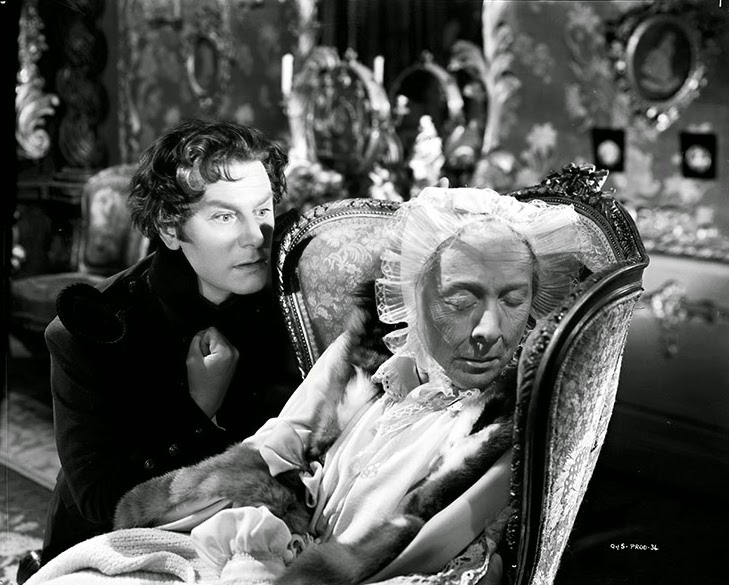
I had wanted to see this film for years; it was impossible to find and, according to Wikipedia, that's because for decades it was a lost film, rediscovered and re-released only in 2009. Based closely on the short story by Pushkin ("Пиковая дама," 1833), it's an incredible British Gothic. Anton Walbrook stars as Herman Suvorin, Captain of Engineers in the Imperial Russian Army circa Napoleon. A working-class German surrounded by aristocratic Russian officers at the height of the faro craze, he doesn't have the money to match his fellows' bets at the gaming tables, he doesn't have an expensive name to draw on when he needs funds, and despite the well-intended interventions of his friend Prince Andrei Narumov (Ronald Howard, looking shockingly like his father), he becomes increasingly resentful, withdrawn, and obsessed. He hears a rumor that the grandmother of one of the junior officers once sold her soul to the Devil for the secret of winning at cards, but he doesn't think much of it until an eerily intense old bookseller urges on him a bound copy of the legends of the Comte de Saint-Germain. Inside, Suvorin discovers a full account of the dealings of the Countess Ranevskaya (Edith Evans, making her film debut at sixty-one and playing thirty years older) with the diabolical Comte—robbed of a fortune by an unscrupulous lover, she turned to the sinister Saint-Germain, allowing him to imprison her soul within a wax figure in exchange for the "secret of the cards," which she used once to dreadful effect1 and then retired from the tables. The Countess Ranevskaya is the very grandmother just mentioned; Suvorin learns where she lives, sees a beautiful, unhappy young woman in the window of the crumbling old palace, and devises on the spot a plan to seduce the Countess' companion, penniless Lizaveta Ivanova (Yvonne Mitchell), and so gain entrance to the house and, from there, the Countess' secrets. As it turns out, everything about this plan is a terrible idea.
Previously I had seen Anton Walbrook in the films of Powell and Pressburger, as the patriotically anti-Nazi community leader in 49th Parallel (1941), the sympathetic co-protagonist Theo Kretschmar-Schuldorff in The Life and Death of Colonel Blimp (1943), and the ambiguous, ultimately tragic impresario Lermontov of The Red Shoes (1948). As Suvorin, he is a rawer, higher-strung character than any of these; without a cause or even an abstract ideal to channel itself into, their familiar intensity becomes feverish, feedbacking on itself until the question isn't whether a mad scene, but when.2 The film presents him initially from a sympathetic position—with the exception of good-hearted Andrei, the young officers come off as a class of spoiled hell-raisers, waiting for the negotiations of their parents and grandparents to ease them up the social ladder while they squander their pay on reckless wagers and paid company. Self-made Suvorin despises them and why shouldn't he? The only thing he has in common with them is his uniform and even then he speaks approvingly of Bonaparte, whom he thinks wouldn't have been given the chance to rise so meteorically in Russia. (The use of British accents for the Russian characters allows Walbrook's German accent to mark Suvorin out as an equal outsider—Herman, Германн when everyone around him is an Andrei or a Pyotr or a Feodor—in Saint Petersburg.) But he wants what they have, and so his contempt curdles into envy, his pride into a compulsion to show them all, no matter how he has to cheat or lie or damn himself to do it.
Suvorin's tragedy isn't that he wants money. I want money. Very possibly you want money. It's the chronic condition of a capitalist society. Suvorin's tragedy is what he's willing to do to get it—and the ironic lagniappe that although he is an antihero, he's not a mastermind. Early in his courtship of Lizaveta, one chilling shot superimposes the spinning of a spiderweb over her face as she sleeps, fingers tight around the passionate letters Suvorin has been sending her, but he's not the real predator at the heart of this snare. Clever and unscrupulous as he is, he's a very poor liar. Confronted by Andrei as to his intentions toward Lizaveta, all he has to do is affirm that he loves her madly, but never received a gentleman's education in expressing his feelings, which explains why he's copying his love letters out of what looks for all the world like a handbook for nineteenth-century pick-up artists; instead he hisses that it's none of Andrei's business, which doesn't look suspicious at all. Caught by Lizaveta in the aftermath of the Countess' unintended death—when pleading for the secret of the cards failed, Suvorin threatened her for it with an unloaded pistol; she dies between one tick of the clock and the next without saying a word, her dead eyes pinpointing the candlelight—all he needs in order to calm Lizaveta's suspicions is to tell her that of course he meant every word he wrote, but what could a foreign engineer of no money and no family offer a girl in the Countess Ranevskaya's household? He needed the secret of the cards to win a fortune, he needed a fortune to win Lizaveta, come on, Herman, any garden-variety sociopath would have this sewn up by now! Instead he stares blankly into the middle distance and murmurs that he never meant to kill the old woman, irreparably breaking the last of Lizaveta's trust in her demon lover and incidentally sealing his own doom. Before the Countess died, he swore he would take the debt of her soul on his own if she gave him the secret. Evidently he didn't read the fine print in all those stories about Saint-Germain. It's marvelously done in that the film leaves the viewer little ambiguity about the hand of the supernatural in Suvorin's downfall,3 but his behavior from the outside is nonetheless psychologically plausible enough that none of his fellow-officers have reason to suspect anything other than an ordinary human nervous breakdown (or, if that was not common terminology in 1806, the strain that sends a man mad). The last words spoken onscreen are unsettling enough that even the obligatory thirty-second upbeat montage can't defang the climax.
I understand why The Queen of Spades was not a success at the time. It is a masterpiece of atmosphere; its cinematography is choked with shadows, of the same texture and density as film noir, but used to pointedly less modern effect. It recalls paintings by Fuseli rather than photography by Weegee. In 1949, its deliberate, dramatic non-realism would have told against it in a culture more receptive to noir, neo-realism, and Ealing comedy. But Pushkin's story is not modern; it has to take place in a world where an ambitious, intelligent man can really believe in the Devil, and where the Devil can come when he calls. It requires its shadows and mirrors and transparencies and underlighting. And the film rewards with one of the best hauntings I have experienced onscreen, where nothing is ever seen: its sound is all the horror it needs. In life, the Countess dragged her frail, aged bones down the halls of her palace, weighted down by the towering wigs and panniered skirts of the fashion of her youth,4 one paper-thin hand clamped on her stick tapping before her. Tap-ssssh, tap-ssssh, a painfully heavy and curiously serpentine sound. As a hungover Suvorin wakes with an occult book and an empty glass beside him, he hears a creak and thump in the same rhythm as the Countess Ranevskaya's progress. It's an open door at the end of the hallway, banging in the snowy wind. He returns to his room and almost at once the sound comes again. This time it's the real thing, and it comes all the way through the door to find him.
1. Framed by Suvorin's reading, the youthful Countess prays to the Holy Mother for mercy, only to see the gentle, luminous faces of the ikons suddenly black out—they become dark, empty recesses, withdrawn from forgiveness or regard. An hour later, preparing to play her Devil's hand, she stakes the little cross she wore to meet Saint-Germain: it is of no use to her now.
2. Minus the mustache, it turns out I find Walbrook both more attractive and less classically good-looking; he appears more Romantic and kept reminding Rob of a contemporary actor, although the movie ran out before we figured out who. Suggestions welcome.


3. As Rob remarked, "Okay, you never drink and do necromancy."
4. Because she is small and stooped and round-faced, frequently fretful, the attire gives her the look of a grotesquely wizened child playing dress-up. Divested of her antique regalia for the night, the dress on its stand like a caddis-fly carapace, the wig decapitated, she attains the dignity of her age. The look she gives Suvorin as he cajoles her for her secret is astonishing in its contempt.
This post was begun much earlier in the day and all but complete before we went out to catch The Razor's Edge (1984) at the Brattle Theatre. Mixed, melodramatic, and only partly successful, but absolutely worth seeing. My major takeaway is that I should see more of Theresa Russell. Anyway. I've got my computer back. I can write tons about film now.
no subject
(a.) The Queen of Spades sounds incredibly interesting; b.) I cannot believe you just solidly recced a Nic Cage film.)
no subject
I thought that at one point, but I wasn't sure if I was being misled by the broad mouth and the falling hair. Thank you! Hm.
(a.) The Queen of Spades sounds incredibly interesting;
Highly, highly recommended if you can find it.
b.) I cannot believe you just solidly recced a Nic Cage film.)
It was very confusing. It looks like a tonal crack-up for like ninety percent of its runtime, where there is the movie everyone else thinks they're in and then there is Nicholas Cage, and then suddenly the movie resolves in Cage's key and it works. I blame Werner Herzog.
no subject
The sound in this film made me so happy. So very happy.
The madness montage was also fun, but the use of sound both stopping and starting were effective and damn good.
no subject
"He was in the technical vanguard during the transition to sound, and his experience in sound-editing left its mark in his often thrilling handling of the relation between sound and image, as well as his Powell-like sensitivity to music . . ."
no subject
no subject
It changes the line of his mouth—it's broader and more delicate without—and it shifts attention to his brows, which aids the intensity of Suvorin's gaze. I'm trying to find other roles he played clean-shaven and so far I'm not coming up with any. Like Ronald Colman with Sydney Carton, Herman Suvorin may have been a one-off sacrifice. With really good results.
GOOD GOD IS HE YOUNG HERE:
(Still in Austria, then; he changed his name when he emigrated. I wish I knew what this was taken for. Google Image was not forthcoming.)
Amazingly contemporary-looking. That pose and that haircut—and that come-hither look—are still gracing articles on up-and-coming male heartthrobs. The mustache could even be gotten in on a technicality.
no subject
no subject
. . . I hadn't made the connection, but you're right. Wow.
Without it, somewhere between Slings and Arrows era Paul Gross and Buckaroo Banzai era John Lithgow?
I'm not sure Suvorin has quite gone the full Emilio Lizardo, but I can see Geoffrey. (It's the hair.)
no subject
You gotta love artists like that.
Nine
no subject
We were trying to figure out afterward what must have been in place before he took over the production and what he brought with him or invented on the spot. The sets and the costumes are elaborate and I am inclined to believe were at least the former director's design, because outfitting an entire cast in more than one change of period clothing is not cheaply done. Dickinson insisted on not showing the apparition of the Countess, which was inarguably the right choice. He does the same with the fatal moment of the Saint-Germain story—the meeting of the Countess with the Comte, the darkness beyond the last door of his palace swallows her and outside the horses go mad—and it works.
no subject
Sounds like a movie worth watching, too.
no subject
Never let the lack of a bread bowl stand between you and chowder! The mushroom cloud was a bonus.
Sounds like a movie worth watching, too.
Highly recommended. I think the restored DVD release is your region, too.
no subject
Interesting that he can't spin a line, either to explain his intentions regarding Lizaveta or to defend himself to her. I gather from what you write that nevertheless it worked--you may have been yelling at the screen, but you felt it went along with his character. He was *meant* to be sort of hapless in his scheming. That's an interesting choice.
Re: your footnote no. 2, I think in that photo he looks like Dustin Hoffman.
Re: your footnote no. 3, yet *another* thing one can't do and drink. Damn! (Wait, maybe damning is something you *can* do and drink.)
no subject
Yes; it doesn't make him look inconsistently written, just out of his depth. And it feels in keeping with his obsessiveness. He has tunnel vision. He hurts Lizaveta badly, but ultimately the only person he entraps is himself.
Re: your footnote no. 2, I think in that photo he looks like Dustin Hoffman.
Interesting! What makes you think of him?
Re: your footnote no. 3, yet *another* thing one can't do and drink.
It is very clearly such a bad idea!
(Wait, maybe damning is something you *can* do and drink.)
Almost inevitably, according to the Temperance movement . . .
no subject
Okay: well, I was looking at the third image, the one on "mustache"--and see if you see any similarity between that and this. Y/N?