


If I was afraid to break or bleed, I would find someone much easier to need
So far this week I have sat in a park with ![[personal profile]](https://www.dreamwidth.org/img/silk/identity/user.png) rushthatspeaks and walked around my neighborhood with choco_frosh, making it my most densely populated social calendar in months. It has been very nice, especially since I have actually slept the last two nights after the abrupt, autumnal temperature drop. I wish I had not forgotten my camera this afternoon, but fortunately Schreiber' had his phone and took pictures for me of the mildly Lovecraftian squash arbor and the flower that looked like tropical broccoli.
rushthatspeaks and walked around my neighborhood with choco_frosh, making it my most densely populated social calendar in months. It has been very nice, especially since I have actually slept the last two nights after the abrupt, autumnal temperature drop. I wish I had not forgotten my camera this afternoon, but fortunately Schreiber' had his phone and took pictures for me of the mildly Lovecraftian squash arbor and the flower that looked like tropical broccoli.

We crossed the street to check out the arbor because I assumed at first that its fruits were some kind of densely packed green grape. They were not.

I have no idea. It looks even more alien to me than the hanging gourds.
Have some more links.
1. Courtesy ofspatch: the treasures of the Tytell Typewriter Archive. "Imagine being so well-known for your craft that letters addressed to 'Mr. Typewriter, New York' would get delivered by the Post Office to your door. Imagine you mount a letter wrong while crafting a typewriter, and it causes a country (Burma) to change that letter to accommodate your mistake. Or that, through decades, your expert testimony about the accuracy of a brand of typewriter and the characters it types means the difference between guilt, incarceration, freedom or the swapping of fortunes. Such was the life of Pearl and Martin Tytell, of Tytell Typewriter."
2. Courtesy ofselkie: Sarah Perry reminds the London Review of Books about real history, not its received and limiting shape. The entire thread is worth reading.
3. I am never sure of the etiquette of sharing reviews (although I would have shared this one sooner, if not for the not sleeping), but I was really pleased by the things Charles Payseur had to say about "The Trouble Over" at Quick Sip Reviews:
A lot of the imagery, a lot of the details, seem to mesh with the life of Isaac Rosenberg, poet and painter. Indeed, the title comes from something he remarked about joining the war that he would eventually die in. The piece captures a sort of history inside the details of his life, his family, showing the ways that war pushed and pulled him, even before he was born . . . it does get to this way that here is something defined by brevity. And what's there is lovely, is strong. But there's also the implication that there could have been more, that shadow that anchors the final lines one that falls over time, that is defined by absence. The shadow is what might have been, is the loss, is the small body of work that remains, reminding everyone not only of the brilliance that was, but the brilliance that was lost on something as tragic and pointless as war. It's a wonderful piece, lingering without losing any of its sharp edge. Definitely a piece to spend some time with!
4. Gemma Files has been writing excellent season overviews of Bryan Fuller's Hannibal (2013–15). I am quoted in the final one. After which I observed that Antonia Bird's Ravenous (1999) is totally Hannibal's idea of a date movie.
5. Courtesy of a friend who is not on Dreamwidth: A Brief History of the Jewish Taste for Horror: A Live Illustrated Zoom Lecture by Jewish Studies Scholar Ilaria Briata. It's in October and requires paying for, but looks really neat. "Will it be thus, the talk posits, possible to speak of Jewish horror?"
Having now watched nearly through the third season of Turn: Washington's Spies (2014–17), it was slightly funnier than it might otherwise have been to walk by the historic house on Sycamore Street—the one with a yard full of poppies in season—and be reminded it was the headquarters of Charles Lee during the Siege of Boston.
rushthatspeaks and walked around my neighborhood with choco_frosh, making it my most densely populated social calendar in months. It has been very nice, especially since I have actually slept the last two nights after the abrupt, autumnal temperature drop. I wish I had not forgotten my camera this afternoon, but fortunately Schreiber' had his phone and took pictures for me of the mildly Lovecraftian squash arbor and the flower that looked like tropical broccoli.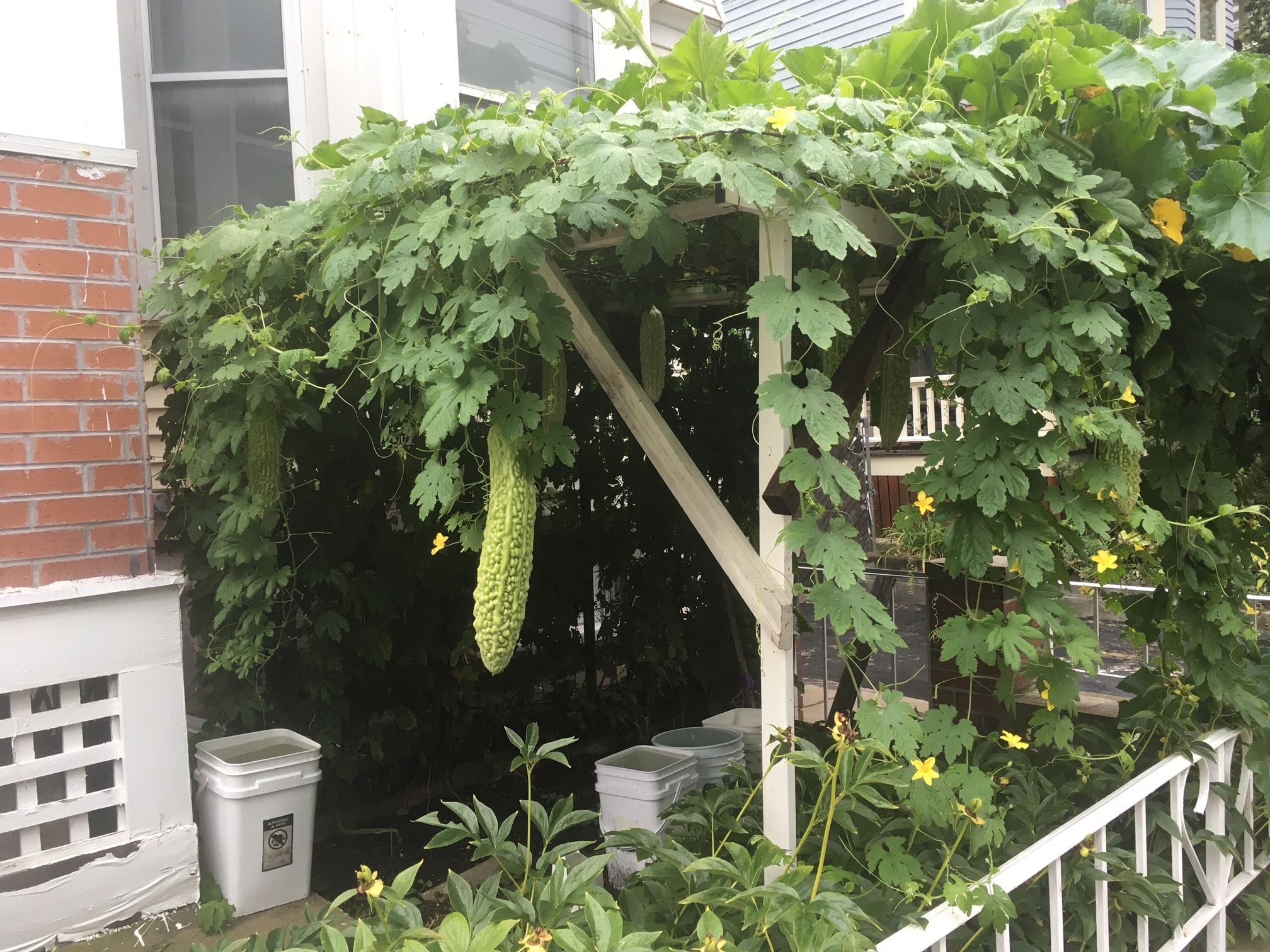
We crossed the street to check out the arbor because I assumed at first that its fruits were some kind of densely packed green grape. They were not.
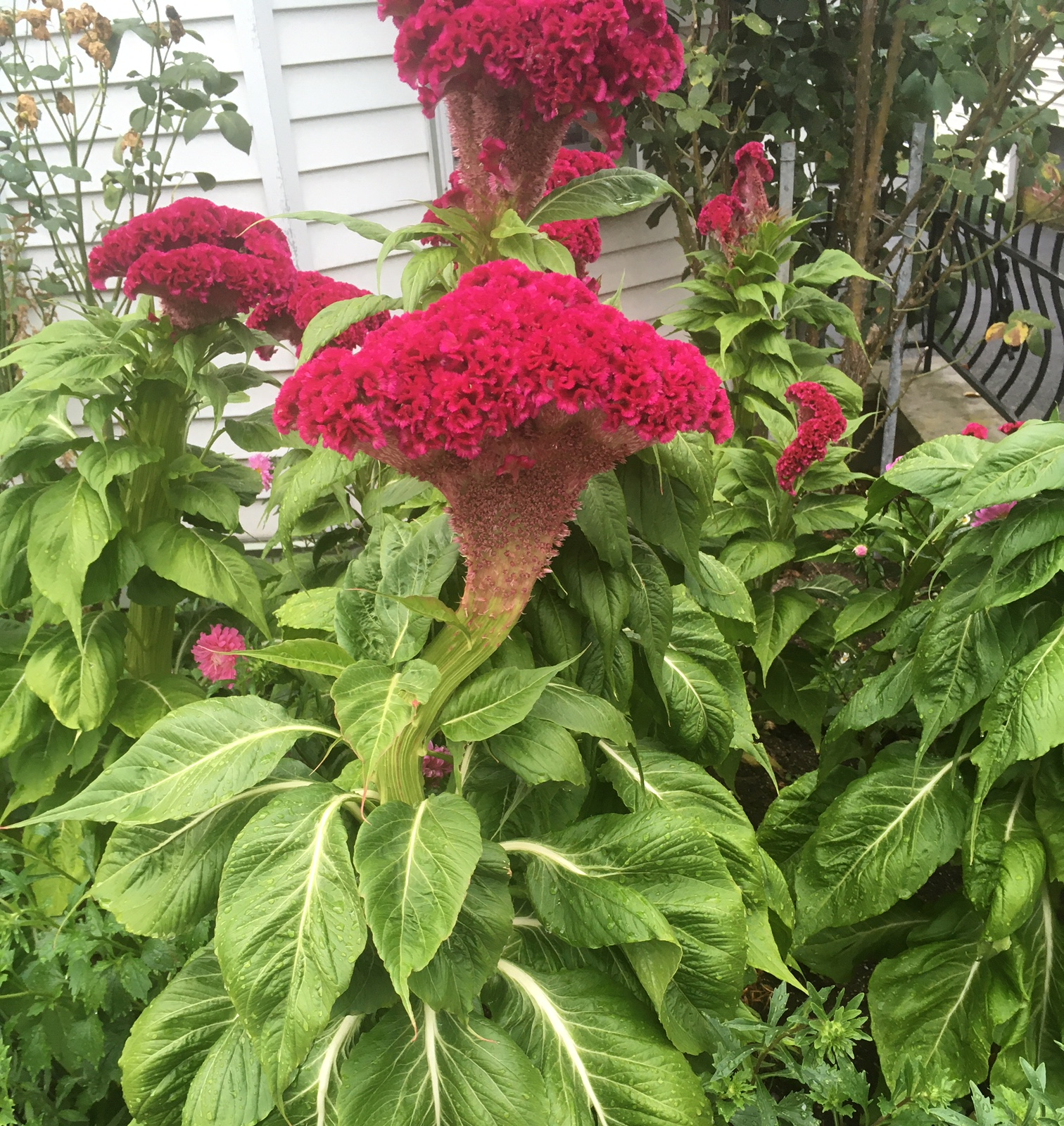
I have no idea. It looks even more alien to me than the hanging gourds.
Have some more links.
1. Courtesy of
spatch: the treasures of the Tytell Typewriter Archive. "Imagine being so well-known for your craft that letters addressed to 'Mr. Typewriter, New York' would get delivered by the Post Office to your door. Imagine you mount a letter wrong while crafting a typewriter, and it causes a country (Burma) to change that letter to accommodate your mistake. Or that, through decades, your expert testimony about the accuracy of a brand of typewriter and the characters it types means the difference between guilt, incarceration, freedom or the swapping of fortunes. Such was the life of Pearl and Martin Tytell, of Tytell Typewriter."2. Courtesy of
selkie: Sarah Perry reminds the London Review of Books about real history, not its received and limiting shape. The entire thread is worth reading.3. I am never sure of the etiquette of sharing reviews (although I would have shared this one sooner, if not for the not sleeping), but I was really pleased by the things Charles Payseur had to say about "The Trouble Over" at Quick Sip Reviews:
A lot of the imagery, a lot of the details, seem to mesh with the life of Isaac Rosenberg, poet and painter. Indeed, the title comes from something he remarked about joining the war that he would eventually die in. The piece captures a sort of history inside the details of his life, his family, showing the ways that war pushed and pulled him, even before he was born . . . it does get to this way that here is something defined by brevity. And what's there is lovely, is strong. But there's also the implication that there could have been more, that shadow that anchors the final lines one that falls over time, that is defined by absence. The shadow is what might have been, is the loss, is the small body of work that remains, reminding everyone not only of the brilliance that was, but the brilliance that was lost on something as tragic and pointless as war. It's a wonderful piece, lingering without losing any of its sharp edge. Definitely a piece to spend some time with!
4. Gemma Files has been writing excellent season overviews of Bryan Fuller's Hannibal (2013–15). I am quoted in the final one. After which I observed that Antonia Bird's Ravenous (1999) is totally Hannibal's idea of a date movie.
5. Courtesy of a friend who is not on Dreamwidth: A Brief History of the Jewish Taste for Horror: A Live Illustrated Zoom Lecture by Jewish Studies Scholar Ilaria Briata. It's in October and requires paying for, but looks really neat. "Will it be thus, the talk posits, possible to speak of Jewish horror?"
Having now watched nearly through the third season of Turn: Washington's Spies (2014–17), it was slightly funnier than it might otherwise have been to walk by the historic house on Sycamore Street—the one with a yard full of poppies in season—and be reminded it was the headquarters of Charles Lee during the Siege of Boston.
no subject
no subject
I'm just sorry I didn't think to ask
no subject
I wonder if the flowers are Cocks'Comb? Just a semi random guess.
(OMG, sleep. blessed cursed sleep.)
no subject
The ones in the shadows at the back of the arbor looked straight out of a Goya painting.
I wonder if the flowers are Cocks'Comb? Just a semi random guess.
No, that looks right. Thank you!
(OMG, sleep. blessed cursed sleep.)
If that means you don't get enough either, solidarity and rest.
no subject
no subject
no subject
What did you do with yours?
no subject
I am more used to seeing bitter melon on a plate than on the vine, but that would make sense!
We saw some honking big zucchini on this walk, too.
no subject
no subject
I think I may never have seen them growing in the wild, therefore did not expect them to be quite so vertical.
no subject
Peel and slice thinly cross-wise, remove seeds if any, stir fry with minced pork, garlic, fermented black beans and dried red chilli (to taste). Eat with rice. That's the commonest Chinese recipe. There are various Indian and Sri Lankan recipes too, and Southeast Asian ones involving fermented fish paste.
no subject
Does the size make a difference to the taste, or just the quantity of leftovers?
Peel and slice thinly cross-wise, remove seeds if any, stir fry with minced pork, garlic, fermented black beans and dried red chilli (to taste). Eat with rice.
Now I want a bitter melon and I definitely do not know the neighbor in whose yard I discovered these ones well enough to ask. I have eaten them in restaurants, but never cooked one at home.
no subject
no subject
no subject
no subject
The typewriter article looks *wonderful*--sending it to Wakanomori.
no subject
I was hoping people would, because of the clematis, and my hope was rewarded!
I knew that gourds grew on vines, because of pumpkins and zucchini, but somehow it had never occurred to me that vines in the case of gourds could mean an arbor. I'm really delighted.
The typewriter article looks *wonderful*--sending it to Wakanomori.
Great!
no subject
no subject
So noted!
no subject
Red and yellow I honestly have no idea, except that yellow probably relates to gold, and therefore to prosperity. Also yellow was the dynastic colour of the Qing and Red was the dynastic colour of the Ming, but whether there was causation, and if so which way it ran, I couldn't say.
Red and white is not as strong or common a thing, but some people avoid it because they interpret is as blood and tears.