
![[personal profile]](https://www.dreamwidth.org/img/silk/identity/user.png)


I want to know how you see you
Tonight in Judaica: I made nearly a hundred hamantashn in four different flavors. (It may have been a hundred before a couple of the more catastrophic outliers got eaten.) The latter part was intentional; the former was a side effect of tripling the usual recipe to make sure that I would have enough to distribute to the various branches of my family and to bring to a social event tomorrow. I definitely do now. It turns out that when you scale up this recipe, you have to add an extra egg to the dough, otherwise it has no cohesion and cracks instead of folding. I always forget how much I like poppy seed paste and how stupid it is that I never do anything with it the rest of the year.
I have received an unexpected unbirthday present from my parents: Werner and Elisabeth Heisenberg's My Dear Li: Correspondence 1937–1946 (2016), edited by Anna Maria Hirsch-Heisenberg and translated by Irene Heisenberg, daughter and daughter-in-law respectively of the physicist and his wife. I've never written about Heisenberg except in context of Michael Frayn's Copenhagen, but he's interested me for long enough that this may change. I was coveting the book at the end of last year, partly because of Werner and partly because Elisabeth as a person is utterly unknown to me. I am holding it in reserve until I have completed several work items, none of which got done earlier today because I was baking ~hundred hamantashn and had to visit three grocery stores in order to find both prune and poppy seed fillings. Several of the blackberry ones exploded, but I have no regrets. (The fourth flavor was apricot, like usual.)
How you can tell your daily life now includes much more discussion of dystopia than it had heretofore: while looking up a biographical detail about Flannery O'Connor for your mother, you run across the following photograph and, ignoring Robie Macauley completely, think, "I didn't know she knew the author of Darkness at Noon."
Have an article about H. P. Lovecraft and Robert Barlow. It succeeded in making me want to read the author's novel.
I have received an unexpected unbirthday present from my parents: Werner and Elisabeth Heisenberg's My Dear Li: Correspondence 1937–1946 (2016), edited by Anna Maria Hirsch-Heisenberg and translated by Irene Heisenberg, daughter and daughter-in-law respectively of the physicist and his wife. I've never written about Heisenberg except in context of Michael Frayn's Copenhagen, but he's interested me for long enough that this may change. I was coveting the book at the end of last year, partly because of Werner and partly because Elisabeth as a person is utterly unknown to me. I am holding it in reserve until I have completed several work items, none of which got done earlier today because I was baking ~hundred hamantashn and had to visit three grocery stores in order to find both prune and poppy seed fillings. Several of the blackberry ones exploded, but I have no regrets. (The fourth flavor was apricot, like usual.)
How you can tell your daily life now includes much more discussion of dystopia than it had heretofore: while looking up a biographical detail about Flannery O'Connor for your mother, you run across the following photograph and, ignoring Robie Macauley completely, think, "I didn't know she knew the author of Darkness at Noon."
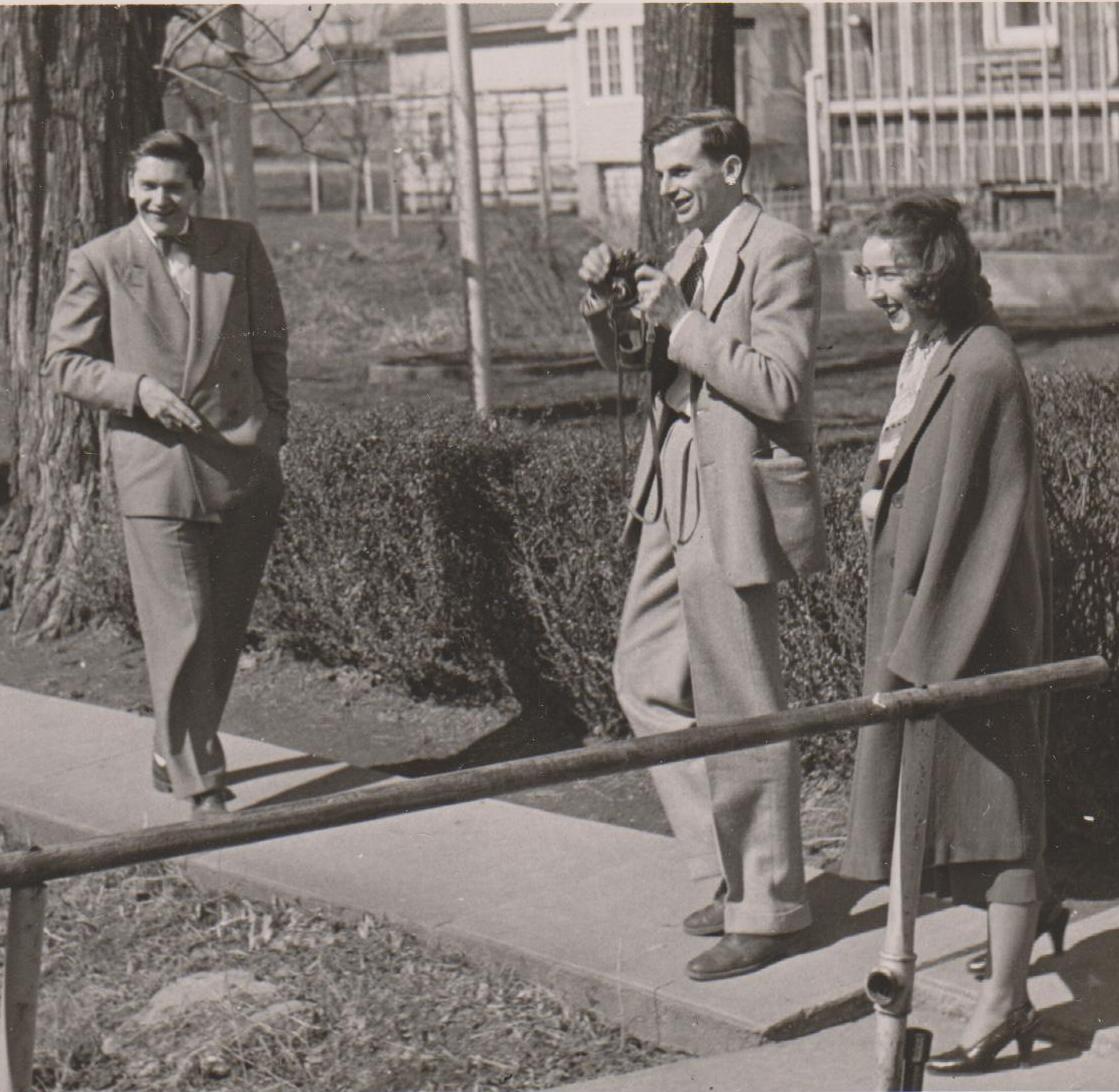
Have an article about H. P. Lovecraft and Robert Barlow. It succeeded in making me want to read the author's novel.
no subject
NYT ran a recipe this week for Hamantaschen with whole wheat flour and I don't see why everything has to have whole wheat flour in it. They also suggest nutella as a filling.
(no subject)
(no subject)
(no subject)
no subject
I've only had hamentaschen once, but they were fantastic. But then, I love all the standard fillings in pretty much every context I've eaten them.
(no subject)
no subject
(no subject)
no subject
(no subject)
no subject
http://www.imdb.com/title/tt3280150/?ref_=nm_flmg_act_9
I was enthralled, but it left a bad taste when I learned later that several of the main characters were complete fabrications. I'm not an author, but why do people do that? The real people were pretty interesting already, and the circumstances were exciting enough (same for "Hidden Pictures").
(no subject)
(no subject)
(no subject)
(no subject)
(no subject)
no subject
We call those "flatmentashen" because that's usually how they end up.
(no subject)
(no subject)
no subject
(no subject)