
![[personal profile]](https://www.dreamwidth.org/img/silk/identity/user.png)


Set follows; chaos follows Set
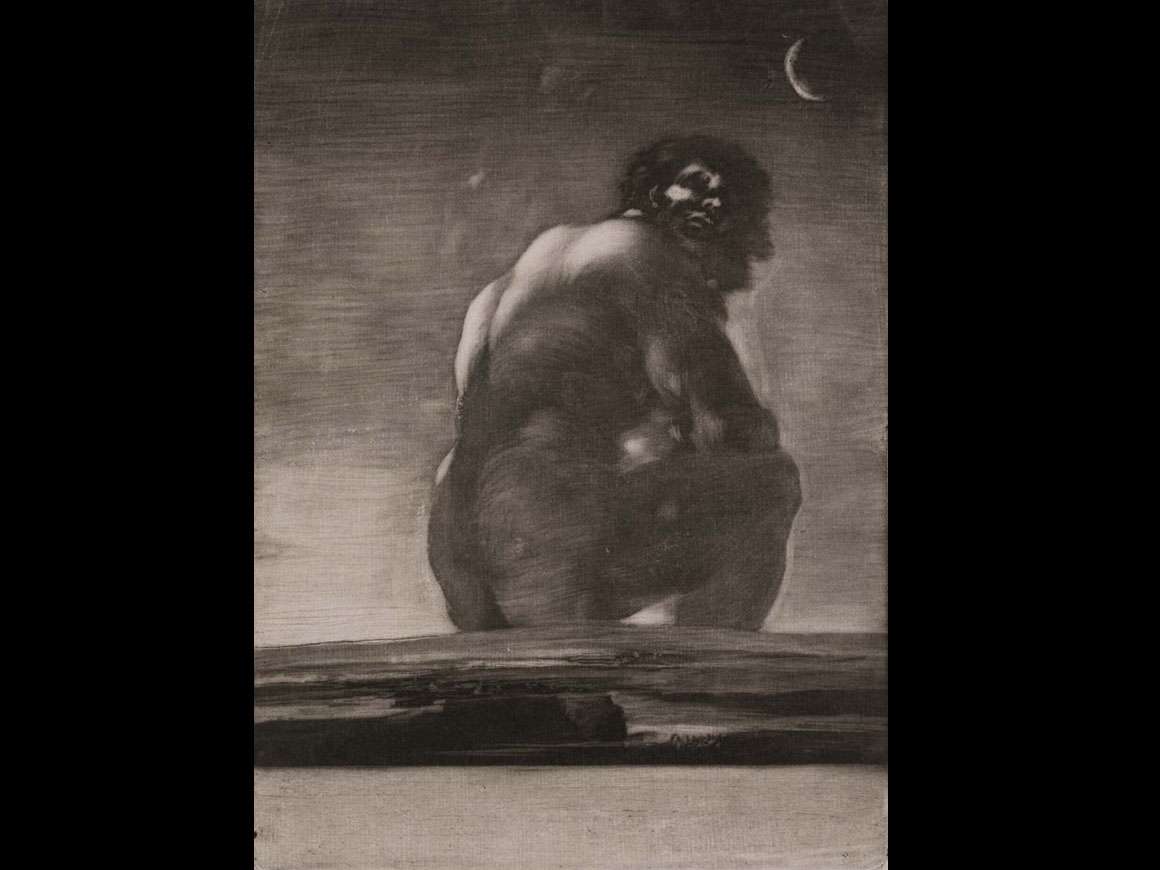
For the fifth of November, which was also our eleventh month of marriage, ![[livejournal.com profile]](https://www.dreamwidth.org/img/external/lj-userinfo.gif) derspatchel and I went to dinner at Magoun's and then to the MFA for their massive traveling exhibit on Goya. It is amazing. I knew him for the Caprichos (1797–99) and some of his grotesque paintings and the cocky self-portrait with candles on his hat. The seated giant was on the same page as Carl Sandburg's "Fog" in Talking to the Sun (1985). I did not know he had ever sketched a man failing roller skates (newfangled in the 1820's!), or documented atrocities of the Peninsular War in a series of devastating prints now known as Disasters of War. He invented a technique for watercolor on ivory and used it for tiny, shadowy cameos, rubbed out of lampblack. He painted full-size, full-color cartoons for tapestries to be woven for the court of Charles III of Spain. (In bright, pastoral colors, four laughing young women toss a scarecrow doll in a blanket—a Spanish carnival custom—its clothes a French dandy's, its painted face smiling rosy-cheeked, head and hands helplessly lolling.) I had seen almost none of his portraits. The one I want to take everyone to see is his portrait of Antonia Zárate, because it does not translate to the small screen. It doesn't look like 1805. In the paint, its golds are as supple and metallic as Klimt, against which the actress herself, so many different shades of pale and dark, looks like one of the women who appear out of shadowed spaces in floor-length portraits by John Singer Sargent. And there is a person in it. You can tell the faithfulness of the artist to his subject because her face is asymmetrical, and beautiful. She regards you a little ironically, but not unkindly. You cannot see online how her earrings glint.
derspatchel and I went to dinner at Magoun's and then to the MFA for their massive traveling exhibit on Goya. It is amazing. I knew him for the Caprichos (1797–99) and some of his grotesque paintings and the cocky self-portrait with candles on his hat. The seated giant was on the same page as Carl Sandburg's "Fog" in Talking to the Sun (1985). I did not know he had ever sketched a man failing roller skates (newfangled in the 1820's!), or documented atrocities of the Peninsular War in a series of devastating prints now known as Disasters of War. He invented a technique for watercolor on ivory and used it for tiny, shadowy cameos, rubbed out of lampblack. He painted full-size, full-color cartoons for tapestries to be woven for the court of Charles III of Spain. (In bright, pastoral colors, four laughing young women toss a scarecrow doll in a blanket—a Spanish carnival custom—its clothes a French dandy's, its painted face smiling rosy-cheeked, head and hands helplessly lolling.) I had seen almost none of his portraits. The one I want to take everyone to see is his portrait of Antonia Zárate, because it does not translate to the small screen. It doesn't look like 1805. In the paint, its golds are as supple and metallic as Klimt, against which the actress herself, so many different shades of pale and dark, looks like one of the women who appear out of shadowed spaces in floor-length portraits by John Singer Sargent. And there is a person in it. You can tell the faithfulness of the artist to his subject because her face is asymmetrical, and beautiful. She regards you a little ironically, but not unkindly. You cannot see online how her earrings glint.
I keep going back to the small new gallery of gems and jewelry from the classical world. If I had amounts of money to burn, I would spend it on ancient gems. I realize this opens me to being a protagonist in a Tanith Lee novel, but at least I'd start out knowing some of the relevant languages, which puts me way ahead of the guy with the sexually transmitted demon.
After the museum closed, we walked to Park Street by way of the Symphony and Newbury Street. Walking down Newbury Street, we heard a man shouting something about forgot your backpack, go and get it and could not tell from his tone whether he was speaking to a dog, to the other man on the corner, to the city in general or someone inside his head. Two or three blocks later, glimpsed kinematoscopically between the cars parked on the other side of the street, I spotted a golden retriever and pointed it out to Rob. Very proudly, like an urban St. Bernard, with its tail plumily waving, it was trotting down the sidewalk with a black backpack in its mouth. He had been speaking to a dog after all. (We saw him and his companion from the corner, walking some ways behind.) That was not the outcome we had been expecting.
Roger Zelazny's Creatures of Light and Darkness (1969) is amazing. I am not surprised it's dedicated to Delany; I am only surprised that it's dedicated to Delany and contains only one sex scene, and het at that, although it's with an oracular supercomputer who will answer her suppliants for only so long as she is sexually satisfied and that must count for something. One chapter is almost entirely in verse. Another is written in the form of a play. The spine is far-future Egyptian myth (with a small amount of Greek syncretism and a cameo appearance from the Norns), the prose is densely beautiful and deliberately combines archaic registers with jarring modernism, the plot is partly nonlinear and you can see the mythic reveal coming for miles and I have no idea where the rest of it came from, except that now I feel I may have been selling Zelazny short when I associate him mostly with the first five Amber novels and one short story collection. Alternately, it's sui generis and I shouldn't feel bad about liking it so much better than what I can remember of Lord of Light (1967).
I remember when Autolycus lay across my laptop and his body was barely its length. Now he is sprawling across the entire left-hand side of the keyboard in pursuit of nursing on one of the buttons on my jacket and he is making it very difficult to type.
derspatchel and I went to dinner at Magoun's and then to the MFA for their massive traveling exhibit on Goya. It is amazing. I knew him for the Caprichos (1797–99) and some of his grotesque paintings and the cocky self-portrait with candles on his hat. The seated giant was on the same page as Carl Sandburg's "Fog" in Talking to the Sun (1985). I did not know he had ever sketched a man failing roller skates (newfangled in the 1820's!), or documented atrocities of the Peninsular War in a series of devastating prints now known as Disasters of War. He invented a technique for watercolor on ivory and used it for tiny, shadowy cameos, rubbed out of lampblack. He painted full-size, full-color cartoons for tapestries to be woven for the court of Charles III of Spain. (In bright, pastoral colors, four laughing young women toss a scarecrow doll in a blanket—a Spanish carnival custom—its clothes a French dandy's, its painted face smiling rosy-cheeked, head and hands helplessly lolling.) I had seen almost none of his portraits. The one I want to take everyone to see is his portrait of Antonia Zárate, because it does not translate to the small screen. It doesn't look like 1805. In the paint, its golds are as supple and metallic as Klimt, against which the actress herself, so many different shades of pale and dark, looks like one of the women who appear out of shadowed spaces in floor-length portraits by John Singer Sargent. And there is a person in it. You can tell the faithfulness of the artist to his subject because her face is asymmetrical, and beautiful. She regards you a little ironically, but not unkindly. You cannot see online how her earrings glint.


I keep going back to the small new gallery of gems and jewelry from the classical world. If I had amounts of money to burn, I would spend it on ancient gems. I realize this opens me to being a protagonist in a Tanith Lee novel, but at least I'd start out knowing some of the relevant languages, which puts me way ahead of the guy with the sexually transmitted demon.
After the museum closed, we walked to Park Street by way of the Symphony and Newbury Street. Walking down Newbury Street, we heard a man shouting something about forgot your backpack, go and get it and could not tell from his tone whether he was speaking to a dog, to the other man on the corner, to the city in general or someone inside his head. Two or three blocks later, glimpsed kinematoscopically between the cars parked on the other side of the street, I spotted a golden retriever and pointed it out to Rob. Very proudly, like an urban St. Bernard, with its tail plumily waving, it was trotting down the sidewalk with a black backpack in its mouth. He had been speaking to a dog after all. (We saw him and his companion from the corner, walking some ways behind.) That was not the outcome we had been expecting.
Roger Zelazny's Creatures of Light and Darkness (1969) is amazing. I am not surprised it's dedicated to Delany; I am only surprised that it's dedicated to Delany and contains only one sex scene, and het at that, although it's with an oracular supercomputer who will answer her suppliants for only so long as she is sexually satisfied and that must count for something. One chapter is almost entirely in verse. Another is written in the form of a play. The spine is far-future Egyptian myth (with a small amount of Greek syncretism and a cameo appearance from the Norns), the prose is densely beautiful and deliberately combines archaic registers with jarring modernism, the plot is partly nonlinear and you can see the mythic reveal coming for miles and I have no idea where the rest of it came from, except that now I feel I may have been selling Zelazny short when I associate him mostly with the first five Amber novels and one short story collection. Alternately, it's sui generis and I shouldn't feel bad about liking it so much better than what I can remember of Lord of Light (1967).
I remember when Autolycus lay across my laptop and his body was barely its length. Now he is sprawling across the entire left-hand side of the keyboard in pursuit of nursing on one of the buttons on my jacket and he is making it very difficult to type.
no subject
*sporfles* I like that version of STD so much more.
(I haven't read anything by Lee post-1990, I think, but still the aesthetic carries on.)
(no subject)
no subject
One of "Disasters of War" was the first thing by Goya I saw (in some middleschool textbook, I think). And when I was a teenager I was somehow fascindted by the story of the latter period of his life, when he became deaf and painted so called "Black pictures" (actually, I saw a play on it) Here is the story of the house (I'm including the Spanish version of the Wiki entry here, it somehow seems more fitting) http://es.wikipedia.org/wiki/Quinta_del_Sordo
(no subject)
no subject
Nine
(no subject)
no subject
... not that I'm saying "give it another chance," your tastes are your tastes, but I get the feeling that Zelazny's not the sort of author who benefits from my usual habit of racing through a book I like to see what happens.
I have not read Creatures of Light and Darkness! I'll have to check that out.
(no subject)
no subject
---L.
(no subject)
no subject
My all time favorite of his is probably always going to A Night In the Lonesome October for the sheer beauty of its anonymous pastiche conceit and the way that allegiances work and utterly fail to work in the run up to the finale. One of these days,
(no subject)
(no subject)
no subject
(no subject)
no subject
Goya's range is astonishing; I'm glad you're having the chance to look at so much all at once.
(no subject)
no subject
(no subject)